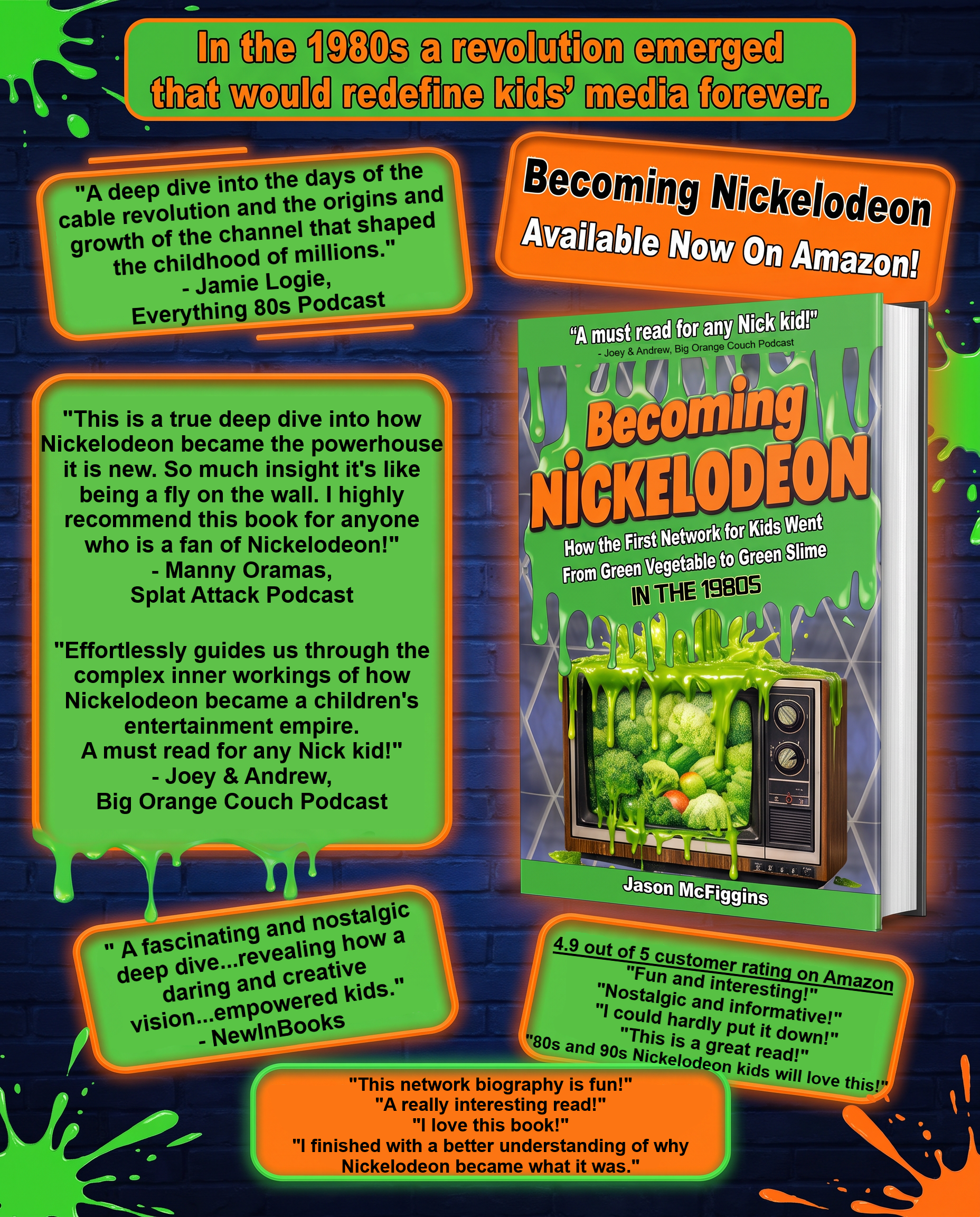
Before Nickelodeon had green slime, it had “green vegetable TV.”
In its earliest days, the network was known for its “green vegetable TV.” Wholesome, well meaning, and almost completely ignored by the kids it was supposed to serve. Parents approved. Children changed the channel.
What happened next is one of the most unlikely creative reversals in the history of American television.
Becoming Nickelodeon is the behind-the-scenes story of how a failing cable channel transformed itself into the first network that truly belonged to kids. Drawing on archival research, sharp cultural analysis, and narrative storytelling, the book traces the bold decisions — and the specific people who made them — that turned a modest preschool program called Pinwheel into a generation-defining powerhouse.
At the center of the story is Geraldine Laybourne, the executive who made a radical bet: stop talking down to children and start listening to them. The result was a creative explosion. Becoming Nickelodeon captures the moment children’s television stopped trying to teach kids and finally began celebrating them.
This is more than a media history. It’s the cultural coming-of-age story of how a group of producers and executives changed television, redefined childhood on screen, and created entertainment that defined a generation.
Read below for free, a new chapter will be posted each week!
To get the whole story now or if you find value in my writing and would like to support my work, the book is available on Amazon in paperback and for Kindle. It’s also available for free on Kindle Unlimited.
Brought on board by Vivian Horner, Geraldine Laybourne was an independent producer with a background in children’s media education. Her acute business sense and creative ability would serve her well at Nickelodeon, a winning combination that can be traced back to each of her parents. Born in the rural community of Martinsville, New Jersey in…
Schneider instilled a strong focus in Nickelodeon, something the network sorely needed, impressing upon everyone that the goal was to “do something good for kids.” He brought on producers very familiar with the industry who in turn brought a very traditional and accepted approach to programming planned for the network. In other words, Schneider’s Nickelodeon…
Building on the successful QUBE model, Warner Amex pressed forward with its national expansion strategy. Scott Kurnit, who had served as program director for QUBE in Columbus, Ohio, relocated to New York to oversee the rollout of new cable franchises and systems across the United States. This initiative targeted several major metropolitan regions, including Cincinnati,…