

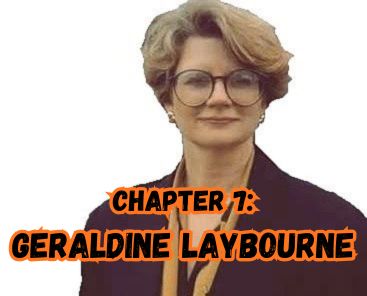
Brought on board by Vivian Horner, Geraldine Laybourne was an independent producer with a background in children’s media education. Her acute business sense and creative ability would serve her well at Nickelodeon, a winning combination that can be traced back to each of her parents.
Born in the rural community of Martinsville, New Jersey in 1947, Laybourne was the second of four children, three of whom were girls. She described her older sister as being “beautiful and perfect,” and her younger sister as being “brilliant and charismatic,” leaving her father, as Laybourne puts it, to name her his “business daughter.” Always supportive of his daughters, her father took Laybourne to work with him, teaching her the ways of business and how the stock market worked. By the age of 16, Laybourne was running her father’s office.
On the other hand, her mother thrived in more creative environments. A writer, producer, and soap opera actress on a radio program, Laybourne’s mother encouraged her kids at a young age to think creatively and open their imaginations. This included teaching art through painting classes and challenging the kids to write their own version of an ending to television shows by turning them off before they were over. Laybourne would later say that having this combination for parents “pretty much left me with no choice” regarding her career path.
Laybourne would graduate from Vassar College in 1969 with a major in art history, a nod to the impression her mother had made on her. Upon graduating she was thinking she’d become an architect and took a job at an architect’s firm in Philadelphia. Laybourne was contemplating going to graduate school in the city, but wasn’t quite sure, saying she took the job to “just make sure that that’s where I was going to go.”
Laybourne would end up going to graduate school in Philadelphia, but not to further pursue her plans to become an architect. While working at the firm, she would meet her future husband, Kit, an animator and graduate of the film school at UCLA who was now a teacher in the Philadelphia public school system. Not only was Laybourne smitten with Kit, but she was fascinated with what he did for a living, describing him as a “media education guru, bringing videotape and animation to schools and working with inner city kids who were terribly troubled.” Laybourne was so inspired by the work Kit did that she wanted to do it as well, enrolling at the University of Pennsylvania for media education.
Laybourne and Kit were married while she pursued her master’s degree, and during that time the newlyweds welcomed their two children, daughter Emmy and son Sam. Laybourne credits her husband for showing her how to have fun. “Just a trip to the grocery store with him turned into a game,” she said. After graduating, Laybourne got a job teaching media at the Concord Academy in 1976, a private school in Concord, Massachusetts. Laybourne said she was teaching “high school students how to teach younger kids how to make movies.” Laybourne herself learned that kids were “savvy little media consumers,” adding that they knew the proper structure of a story. “What we tried to do was give them a voice, give kids a chance to help shape the kind of media they consumed.”
During her time at Concord Academy, Laybourne travelled with her children into the inner-city schools of Boston to talk about media and make videotapes with other kids. It was an eye-opening experience for her, with Laybourne saying it gave her “a primary orientation to kids and the way kids see things.” This direct observation of how the kids interacted with and made media offered Laybourne a different point of view regarding the way television could benefit children, and vice versa. Comparing what was being offered to kids on television and what they were creating as a group, Laybourne saw a disconnect. “They seemed infinitely more tolerant of interesting, different styles and different genres of programming than what was being offered to them.”
Just like when she became fascinated with media when she met Kit, Laybourne again became fascinated with media for children after her experience in Boston. With this new passion, she left the Concord Academy after only one year and her family moved to New York where Laybourne co-founded a nonprofit organization in 1974 called the Media Center for Children. “The objective was to help teachers bring media into the classroom and also to broaden the concept of what kids want,” Laybourne said. She continued to explore and study the topic, which included writing a couple of books called Films Kids Like and What To Do When the Lights Go On, and utilizing her own kids to understand the minds of children. “I had two small kids at home,” said Laybourne. “I was able to really explore and formulate some of my theories.”
Acknowledging the large community of independent filmmakers in New York City, Laybourne teamed up with her husband, Kit, and an animator named Eli Noyes (whom she referred to as one of the “freshest creative minds” she’d ever seen), to form a production company in 1978 called Early Bird Specials. Started with money from former IBM CEO Thomas Watson, Jr., the objective of the small production company was to bring the work of independent filmmakers to television. The first project Early Bird Specials did was with Nickelodeon, the new children’s network looking for programming. “We did two pilots for Nickelodeon in 1979, and they were very esoteric and very way out there,” said Laybourne.
The “way out there” pilot that Laybourne referred to was an experimental new show called Video Dream Theater. The idea behind the show was to place kids within their own dreams through animation. Utilizing dreams to display the endlessness of a child’s imagination sounded like a show kids would be interested in. To achieve this, various techniques were used such as color photocopying the kids into an animated dream world, which included a mask created by future Academy Award nominee Julie Taymor. The result was a show that sounded better in the idea and production phase but was lacking in its final execution. While Laybourne called the pilot “brave” and observed it was “pretty interesting for a parent or a filmmaker,” she also acknowledged the failed show was “excruciatingly bad television.” “Kids dream about abandonment, suffocation, it’s just terrible,” she said.
Laybourne was on a mission to “aggressively” acquire shows to strengthen Nickelodeon’s program schedule. “I remember so distinctly how I used to spend my weekends,” said Laybourne, “I would ship tapes home, and I would get my two little kids in the pull-out sofa and we would sit there and just screen tapes all weekend long.” Laybourne was not only relying on her sense of quality children’s programming to help her decide what Nickelodeon should take a chance on, she was also utilizing her own children as a test audience. This scenario appears to be a win-win for all involved: Laybourne got immediate feedback from her network’s target audience, and her kids got to sit on the couch and watch television.
While Laybourne may have been questioning the direction Nickelodeon was taking to differentiate it from other networks, she recognized the importance of offering children television programs that were not only entertaining, but also beneficial. She shared Schneider’s commitment to bringing “good” programming to kids, believing that such content could positively impact young viewers. In pursuit of this goal, Laybourne partnered with a Canadian company to co-produce a show called Going Great, which continued Schneider’s “green vegetable” model of programming.
The concept behind Going Great was to showcase talented children, including musicians, artists, and gymnasts. Laybourne’s motivation for developing the show stemmed from her background as a teacher and researcher, as well as her experience working with others in the educational field. She explained, “I wanted to give kids positive role models on television, to help them become better citizens of the world.” The program aimed to inspire its audience by highlighting the achievements and abilities of young people, offering models of excellence and creativity for viewers to emulate.
Approximately one third of Nickelodeon’s already limited programming budget was devoted to the production of Going Great. The network’s executives were confident in the show’s potential, firmly believing they had discovered a winning formula. Going Great was not only expected to be a hit with audiences, but also to serve as a source of enrichment and inspiration for children watching at home. “We put it on the air as proud as could be,” said Laybourne.
Then the unthinkable happened. Nickelodeon’s viewership experienced “an enormous” drop in ratings when the show aired. According to Laybourne, this drop off in ratings happened “almost instantly.” “I couldn’t understand it,” she said, “we had had such high hopes for this series.”
Laybourne had to find out why Going Great didn’t catch on with kids, and, more importantly, how they could be so wide of the mark about what their viewers wanted to watch. When they brought in a focus group to get instant feedback on the show, Laybourne and the others found out why kids were tuning out when Going Great came on. “Instead of inspiring them, it was having the opposite effect: seeing such perfect children was depressing them,” said Laybourne.
Going Great was the epitome of the green vegetable TV era during the early days of Nickelodeon. What parents and adults thought was good for children may have been a noble and well-intentioned goal, but it wasn’t what kids really needed or wanted. By trying to inspire kids by showing them other kids who excelled in various talents, the network was leaving the children watching to feel insignificant and unworthy. “What we were doing was squashing any ambitions they did have by showing them a variety of things they couldn’t do,” concluded Laybourne.
After the disappointing results of Going Great, Laybourne recognized the urgent need for Nickelodeon to reevaluate its approach to children’s programming. She emphasized the importance of abandoning preconceived notions about what adults believed children needed, advocating instead for a genuine effort to understand and respond to what kids actually wanted to see on television. “We needed…to get rid of our prejudices about what we thought kids needed and listen instead to what they wanted,” she explained.
This realization prompted a decisive break from the previous direction. The network terminated its three-year contract with the Canadian production company and removed Going Great from its lineup after just one year on the air. The cancellation was a costly decision, resulting in financial losses that Nickelodeon could scarcely afford. However, the experience proved to be a crucial catalyst, guiding Nickelodeon toward a new strategy that focused on listening to its young audience and better addressing their interests and needs.
Laybourne realized that children’s lives could still be changed for the better without being preached to or told what was good for them. What if instead the network listened to what kids said was good for them? What if children and their needs, along with their wants, were taken seriously? “We became less idealistic,” said Laybourne, adding that the mistake of Going Great was a valuable lesson in figuring out what wasn’t working on the network.
From then on Laybourne took a focus group approach to finding what Nickelodeon’s actual viewers, not just their parents, wanted to watch. This practice led her to a simple conclusion: “We spend a lot of time finding out about the sort of problems [children] are going through, then use humor to help them deal with those situations.”
The same year Going Great debuted on Nickelodeon, another show that was acquired from Canada also had its premiere. The show, a sketch comedy show starring kids, was the antithesis of green vegetable TV, and solidified every conclusion drawn from the Going Great debacle. The show was called You Can’t Do That on Television.
Stay tuned for chapter 8, coming next Thursday!


Leave a Reply