

Schneider instilled a strong focus in Nickelodeon, something the network sorely needed, impressing upon everyone that the goal was to “do something good for kids.” He brought on producers very familiar with the industry who in turn brought a very traditional and accepted approach to programming planned for the network. In other words, Schneider’s Nickelodeon would play it safe by presenting programming that would be “uplifting, inspiring, informative, or educational.” This was an understandable approach for a network that, at the time, was trying to win over adults more so than children. This is evidenced by a 1980 Nickelodeon promotional video that was a pitch to cable operators.
After the Warner Amex Satellite Entertainment Corporation whooshes onto the screen, the middle-aged Schneider is seen wearing a suit and standing in front of a banner that reads: Nickelodeon- The Young People’s Network. The rather bland network tagline aside, Schneider explains the philosophy of Nickelodeon to be “entertaining and stimulating.” He then coined the phrase “edu-tainment,” meaning Nickelodeon would be informative but not in the “teach in a classroom sense.” Schneider wanted the shows on Nickelodeon to encourage and expand childhood imagination with a focus on art, music, and science. He then leans on the network’s flagship show and introduces characters from Pinwheel, including George James. James encourages the puppet Ebenezer to “say hello to all those cable operators.”
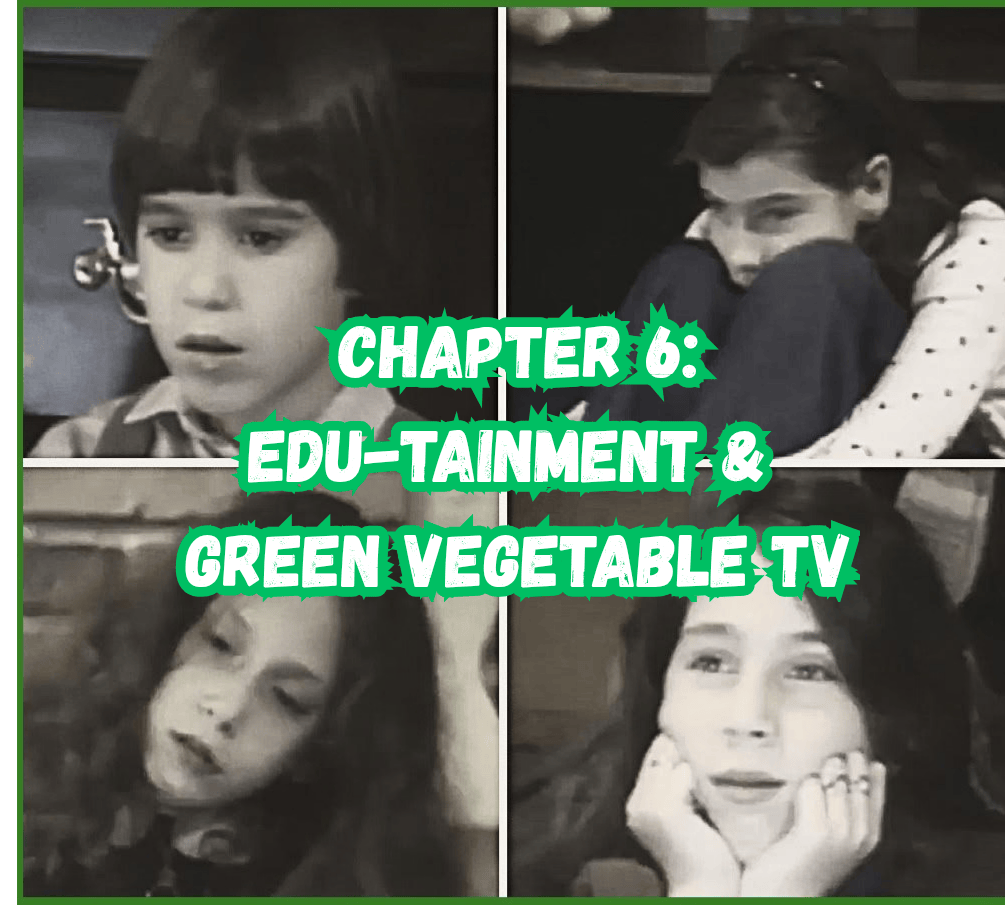
“Our basic goal is top quality, constructive, enjoyable entertainment,” said Schneider as he conversed with the puppets of Pinwheel House. At that moment, five children are depicted viewing Nickelodeon in a living room environment, with an awkwardly positioned bunk bed serving as their seating arrangement. As the camera focuses on each child individually, their faces remain entirely neutral, exhibiting no discernible emotion. The voice over in the promo then says Nickelodeon “may be the most parent approved programming on television,” and reminded cable operators of their franchise commitment to serve the public interest. Parent approved perhaps, but the kids didn’t look too interested.
This promo was a lot more specific and detailed than the one from a year before. Nickelodeon was forming an identity under Schneider, one of, as he put it, “edu-tainment.” Pinwheel was already a success, and that show could be categorized under Schneider’s coined phrase of edu-tainment, so perhaps building the channel around this premise was a strategically smart idea. One mistake the channel would avoid would be simply creating Pinwheel copycats, and a wide range of new programming was introduced, all falling under Schneider’s “uplifting, inspiring, informative, and educational” mantra.
Before and at the time of Schneider’s hiring, the shows airing on Nickelodeon were Pinwheel, Nickel Flicks, Hocus Focus, By The Way, Video Comics, and America Goes Bananaz. Including the backlog of Pinwheel episodes from the Columbus QUBE days, these programs were largely made up of existing content from the Warner vaults, as well as acquired movies from several film production companies.
Debuting on Nickelodeon just before Schneider was hired was a show called PopClips, which premiered in March of 1980. John Lack, hired by Gustave Hauser in January 1979 to be the manager of programming at QUBE, brought the idea for music-based programming from England. While there, Lack noticed video music clips played in movie theaters before and after the film to help promote records. This was also done on television and Lack saw an opportunity to broaden the demographic reach of Nickelodeon by producing music clips in the studios in Columbus, Ohio.
The man behind the music video clips that Lack saw was Michael Nesmith, formerly of The Monkees. The video for his song “Rio” was more of a short film rather than Nesmith simply lip-syncing on a stage. Lack then asked Nesmith if he and William Dear, who directed the “Rio” video, could make more video clips featuring songs. “These were eventually bundled into a one-hour segment on Nickelodeon called PopClips,” said Hauser. Hauser then added that the QUBE computers showed growing audiences tuning in to watch PopClips on Nickelodeon, proving the concept to be a hit with teen audiences.
Despite the innovative concept and growing popularity of PopClips, the program ultimately did not align with the educational standards that Schneider mandated for Nickelodeon’s lineup. Schneider was committed to ensuring that all shows on the network were “good for kids,” emphasizing uplifting and informative content. Because PopClips lacked the educational component that Schneider valued, the decision was made to cancel the show in early 1981. However, the success of PopClips did demonstrated to Warner Amex that pop music videos as television programming was a successful formula. This insight paved the way for the August 1, 1981 launch of an all-music television channel called MTV.
First Row Features, sometimes mistakenly referred to as Front Row Features, was another program commissioned for Nickelodeon before Cy Schneider’s tenure. The show consisted of movies acquired by the Warner Amex Satellite Entertainment Corporation specifically for the Nickelodeon lineup. These films originated from the vaults of the British Children’s Film Foundation (CFF), offering a broad selection that included comedy, adventure, and documentary genres.
Nickelodeon produced an original claymation introduction for First Row Features, depicting a group of animated figures entering a movie theater and settling into their seats to watch the show. However, aside from this unique opening sequence, the content of the program relied entirely on pre-existing material sourced from the CFF collection. First Row Features would air until 1982.
Under Schneider, new programs such as Reggie Jackson’s World of Sports, Standby: Lights! Camera! Action!, Against The Odds, What Will They Think of Next?, and Livewire were added to the Nickelodeon lineup.
Reggie Jackson’s World of Sports aired from 1981-1982. Hosted by the baseball legend, the show featured junior sporting events and interviews, with the kids playing the sports being heavily featured. The show was partly inspired by Cy Schneider’s experience with his own kids. “I wanted to do a different kind of sport program,” he said. “All four of my kids are participants in one sport or another.” His two daughters were championship rodeo riders and Schneider himself used to manage a little league team. “This program gives kids a chance to watch the best kids in the country in their sports,” he said. In addition to the kids, the program also featured interviews with their parents and coaches. Schneider’s hope for the program was to encourage kids to find the sports they could participate in.
According to Schneider, the show “provided lessons about the life values gained from sports involvement.” Nickelodeon took a unique approach to sports with this show, allowing the kids watching at home to see kids playing the sports they usually would only see adults play on television. While the network stayed with a more traditional approach to children’s television, Reggie Jackson’s World of Sports was the first show on Nickelodeon that showed kids being kids. Although it only lasted 18 episodes it was an early adoption of the formula that would set the channel apart in just a few short years.
Other edu-tainment type shows dealt with biographies of historical figures and entertainment itself with a show about the movies. And Nickelodeon got a couple of familiar and known actors for the hosting duties. Granted, the actors were probably more familiar to parents than their kids, but perhaps the kids would recognize them from the shows their parents watched. Actor Bill Bixby (The Incredible Hulk) hosted Against The Odds, an educational half hour biography program that introduced kids to, as Schneider put it, “heroes and heroines, and a few villains.”
Hosted by Leonard Nimoy of Star Trek fame was Standby…Lights! Camera! Action!, a show that brought kids behind the scenes of the movies, showing how makeup and special effects worked while also promoting upcoming films. When it comes to catering to its young audience, the show was a mixed bag at best. The host was again someone more familiar to parents than kids, and the films covered in each episode varied wildly. One episode that focused on costumes covered Return of the Jedi, no doubt exciting for kid viewers, but also featured Monty Python’s The Meaning of Life and Jackie Gleason’s con man get up in The Sting II. While attention grabbing movies such as E.T. and Conan The Barbarian were spotlighted on the show, it’s hard to imagine children caring about or grasping The Meaning of Life or having any interest at all in The Sting II.
Kids’ Writes premiered in December 1981, offering new episodes until 1983. The show was built around a concept developed by a troupe of five actors known as Magic Carpet — Carlo Grossman, Jim Mairs, Steve Riffkin, John Rousseau, and Wynn White — who had already spent over a decade performing their Kid’s Writes idea in live settings. Recognizing the potential in this unique approach, Nickelodeon first aired a special of one of these performances before committing to a full series.
The format of Kids’ Writes emphasized audience participation, making it stand out among children’s programming of the time. Children watching at home were invited to contribute by submitting their own stories, poems, dreams, or any form of written content. The five adult actors then brought these submissions to life, performing them on a minimalist stage that focused attention on the creativity and imagination at the core of each piece.
In addition to enacting written submissions, the cast performed original songs and interacted with the in-studio audience. For example, they would take suggestions from the children present, such as which animals the actors should portray. While the idea of adults embodying the thoughts and stories of children may seem unusual, Kids’ Writes succeeded in creating an environment where young viewers felt heard and valued. By involving kids directly in the creative process, the show gave children viewers an inkling of what Nickelodeon needed: the idea that the network genuinely cared about their ideas and voices.
Taking the place of America Goes Bananaz after it was cancelled after one year on the network was a virtual carbon copy called Livewire. Why the former show was taken off the air only to be replaced by another with the same exact format can’t fully be explained. The only guess one could make is perhaps with the 1970s giving way to ’80s, the people running Nickelodeon felt the need for a fresh look, ditching the very ‘70s golden neon look of America Goes Bananaz. Replacing it was a more muted, and oddly mature, beige and red. While that doesn’t seem like enough of a justification for a complete revamp of the network’s most fun show, another theory could be that host Randy Hamilton didn’t want to make the move to New York where Livewire was filmed in the Ed Sullivan Theater.
With the new show and a new location, a man named Mark Cordray was named as host. Cordray would be replaced in 1981 by a 29-year-old writer named Fred Newman. Newman was a better fit for the vibe of the show, displaying a fun and outgoing personality. His personality gave him the ability to balance the heavy subjects the show tackled, such as suicide and abortion, with the more lighthearted segments like a performance by rock band Twisted Sister or a demonstration by Friday The 13th special effects guru Tom Savini.
Schneider referred to Livewire as a Phil Donahue Show for teens, while describing host Fred Newman as not belonging to the adult or kid world, but rather “somewhere in between.” Perhaps Schneider’s interesting description was alluding to Newman’s goofy nature that put both him and kids at ease in each other’s presence. This same ability wouldn’t seem to make for a successful host of a more adult-themed talk show. With this observation, Schneier seemed to know what he had in Newman, and the popularity of Livewire confirmed it.
With its ability to address the concerns of young people while also entertaining them with fun segments relevant to their interests, Livewire is perhaps the most successful of Schneider’s approved programming. The blueprint for Livewire may have already existed with America Goes Bananaz, but Livewire was the best of Schneider’s “edutainment” philosophy.
Much like purchasing children’s films from film vaults, or packaging pre-existing studio content into framed television segments, another affordable way to fill a programming schedule was to acquire older television shows from around the world. “Most of the new cable programmers obtained their programming in the same way,” explained Gustave Hauser. “Not being able to afford original programming, they bought and recycled existing programming.”
To give an idea of how little money Nickelodeon had to work with, a good comparison would be to Sesame Street, easily the most popular and critically lauded children’s program. About two years into Nickelodeon’s existence, the budget was roughly $10 million for the entire network. Twelve years earlier in 1969, the initial startup and production cost for Sesame Street’s first season was about $8 million. Then again, Sesame Street had government funding to rely on. To fill 13 hours a day with quality television on such a meager budget left the people in charge of Nickelodeon with no choice but to be as frugal as possible.
The show most similar to the popular Pinwheel was Dusty’s Treehouse, a tried-and-true children’s program that originally aired on CBS from 1970 to 1980. The show featured Dusty (Stu Rosen), a human character who interacted with his puppet friends. Like Pinwheel, the show featured musical numbers and focused on getting along and problem solving. Nickelodeon aired reruns of Dusty’s Treehouse from 1980 through 1984. This was another show that dealt with child development and fit the mold of what Schneider wanted on the air.
Today’s Special was another show that followed the Pinwheel model, pairing human and puppet characters, and made sense to acquire along with Dusty’s Treehouse. Brought in from TVOntario in Canada, Today’s Special took place in a department store after closing. It followed the adventures of Jodie, (Nerene Virgin) the store’s display designer, Sam, a puppet and the store’s security guard, Muffy Mouse, a puppet mouse who lived in the store and spoke in rhymes, and Jeff (Jeff Hyslop), the store mannequin that came to life with the aid of a magic hat and someone saying “hocus pocus alimagocus.”
Because Jeff is a mannequin, he doesn’t know a lot about the world. As a result, a lot of Today’s Special involves Jeff learning about objects around the store, mostly with Jodie explaining what things are and what they are used for. These learning moments for Jeff were also learning moments for the young viewers watching at home. Similarly to Pinwheel, teachable moments frequently involved singing and dancing. Hyslop’s extensive background in theatre and dance contributed significantly to his performance. Today’s Special ceased production in 1987, but its run on Nickelodeon was one the most successful during the early years of the young network.
Nickelodeon further enhanced its programming lineup by acquiring a couple of classic television shows renowned for their strong family values. One such show was The Adventures of Black Beauty, imported from England. Set in 19th century England, this series was highly esteemed by Cy Schneider, who considered it one of the greatest animal shows ever produced. Through Nickelodeon’s exclusive United States broadcast rights, all 52 half-hour episodes of Black Beauty were made available, with approximately half of these episodes airing for the first time for American audiences. Schneider lauded the program for its high production standards and compelling performances, noting that its “entertainment and literary values have withstood the test of time, making it perfect fare for Nickelodeon.”
Another notable acquisition was Lassie, a family and animal-themed classic. By airing Lassie reruns Nickelodeon offered viewers more content centered around wholesome themes. Both Black Beauty and Lassie not only imparted moral lessons but also provided engaging stories featuring children interacting meaningfully with the lead animal characters.
Schneider again made sure that these shows adhered to his edu-tainment philosophy. Like Reggie Jackson’s World of Sports could teach about teamwork and dedication, Black Beauty and Lassie could teach kids about compassion and caring for all living things by watching a bond form between a human being and an animal. “We are trying to combine the entertainment appeal of television with other values,” said Cy Schneider. According to Schneider those values could be informational, pro-social, getting along with others, or literary. Under his supervision, Nickelodeon’s programming would always feature some form of value for the viewer to learn. “…We don’t play anything that is pure entertainment but not anything else,” he said.
Schneider even implemented an educational interactivity between the channel and viewer that started airing in February of 1982. Nickelodeon Arcade was a series of game-based mini-programs that aired between the channel’s full-length programs. Schneider said the games were created to inspire “active television viewing.” Five pilot episodes were created that introduced different games in different environments.
Two were based on outer space: Starbase One and Mission in Space. Starbase One utilized geometric shapes by asking viewers which docking bay would correctly fit specific spaceships. Mission in Space used factual information about space that viewers had to use to solve mazes and maps. Make-A-Word was a game that asked how many words could be made from words shown on the screen, while The Vocabulator was a funny computer that scrambled words and asked viewers to unscramble them. The final game was called M.A.S.E (Museum of Adventure and Scientific Exploration), an exploration game that prompted viewers to create their own adventures like treasure maps. Schneider said these active viewing experiences would motivate kids to find out more about space or create their own games and adventures.
What Will They Think of Next? was a product of Canada, acquired by Global Television in Ontario, and produced by Science International, airing from 1976 to 1979. Beginning in 1980 and lasting through 1981, the show aired daily on Nickelodeon. Acquiring the show was again a way for Nickelodeon to bolster its program schedule without the cost of producing a show, something the young network didn’t have the extra money to do.
Hosted by television veteran Joseph Campanella and Kerrie Keane, What Will They Think of Next? explored advances in science and technology. The production quality of the show was low, often using animated graphics or simple talking heads to accompany discussions, but a documentary approach mixed with an infomercial-like energy saved the show from being a complete bore.
The kids watching at home were likely mildly amused watching What Will They Think of Next?, perhaps even interested in some of the content they saw. But the show was clearly produced for educational purposes. It was the kind of video kids watched in school that tried to make learning fun. What Will They Think of Next? was the kind of show kids wouldn’t choose to watch but might pay attention to for a little while if their parents put it on for them.
If the programs were still largely pre-existing and recycled, an easy way to spruce up the network’s look was to debut yet another new logo. In 1981, a more colorful logo designed by Bob Klein and Lou Dorfsman made its debut. This new logo had Nickelodeon spelled out with the colors of the rainbow in Frankfurter typeface (designed by Dorfsman) in front of a reflective silver ball (designed by Klein) like one found in a pinball machine. This was another improvement over the previous logo, with the more fun, childlike lettering and pinball a step in the right direction towards the modern interests of kids.
But still, a silver pinball with rainbow-colored letters continued to appear as a signal to adults instead of an emblem for kids. The new logo followed the same familiar pattern as the programs. The network was still in an adult-first mindset, letting parents know that this was television they would like their kids to watch. Schneider wasn’t wrong in thinking that, but the new logo, along with its programming, seemed merely a safe combination of things that adults thought kids would like.
The channel was making a noble effort in attempting to build a wholly unique lineup and offering children a lot more than mere cartoons like the three major networks. Schneider and the network strived to not only educate children but to encourage them as well. These shows demonstrated to kids what was possible and attempted to expand their imaginations. Instead of the zapping of superhero cartoons or zooming of animated cars, Nickelodeon opted for mostly real people talking about real things. Schneider acknowledged this at the time by saying, “we’re trying to bring an encyclopedia to a world that’s up to its armpits in comic books.” This is Schneider yet again staying true to his philosophy of entertaining children, but with an educational intention. He even had his eye on potential merchandising, looking to build up a stable of characters and personalities that could be licensed to toy and game manufacturers.
These efforts at programming and branding led to a critical question: was Nickelodeon truly fun for its intended audience? Despite the network’s attempts to provide educational and value-driven content, it remained unclear whether children actually enjoyed watching Nickelodeon or if they sought it out on their own. There was no indication that kids would be enthusiastic enough about the shows or characters to want merchandise, like a Kryspen action figure or a What Will They Think of Next? board game. More likely, children tuned in when their parents chose the channel for them, rather than out of genuine excitement or desire to watch the programming themselves.
When Cy Schneider said, “America Goes Bananaz talks with young people, not at them,” in the 1980 promotional reel, it was the first inkling of the direction Nickelodeon should, and would eventually, take. But that show, along with Schneider’s Livewire, was geared more towards teenagers, not the younger crowd Nickelodeon was really going for with the bulk of its programming. Kids at the time didn’t feel a part of these shows, perhaps with the exception of Reggie Jackson’s World of Sports, which at least showed kids playing and talking about sports.
However, a man from the middle ages using film to explain the modern world in Hocus Focus, or adults exploring the possibilities of science in What Will They Think of Next?, and Leonard Nimoy talking about movies didn’t leave kids thinking they were part of the conversation of what they were watching. They may have been mildly entertained, but, unlike America Goes Bananaz, Nickelodeon wasn’t talking with kids, it was talking at them. More fun and spontaneity like that seen in America Goes Bananaz was what the channel needed for the to catch on with kids and not just their parents or cable providers.
While Nickelodeon’s programming was of quality and beneficial to children in many ways, over the course of the next few years Nickelodeon continued to struggle in finding an identity. More importantly it struggled to completely differentiate itself from public television and prove to kids that it was a network they needed to watch. Warner essentially used the network as a lure for cable operators to subscribe and pay the fee of 15 cents per subscriber. Warner Amex viewed the cable operators as being more important than their young viewers when it came to Nickelodeon. After all, if cable operators paid the fee and parents felt good about having a children’s programming option, what difference did it make what the kids thought?
This mentality led to Warner investing only $20 million into the network from 1980 through the end of 1983, and personnel associated with Nickelodeon at the time referred to Schneider’s vision as a “green vegetable” approach to children’s television. This approach, like the slate of shows acquired and produced under Schneider’s watch, seemed to be designed to make parents happy more so than the children. Much like green vegetables at dinnertime, it was television parents could feel good about letting their kids watch, programming that was good for them, but that kids didn’t necessarily want to watch. It was clear that the creativity Schneider applied to advertising children’s toys wasn’t translating to children’s programming.
Though far from ideal, the tiny office space during these early days of Nickelodeon was a hothouse of creativity where collaborative thinking thrived. The lack of space also created an atmosphere where secrets or criticism were virtually impossible to hide. In fact, the office spaces were so tiny that one office was shared by four of the six employees there, and “the whole crew had to vacate the room each time anyone needed to step out.”
With what was called a “very close family atmosphere,” the close quarters worked well for creative collaborations, but it also functioned as a permanent water cooler type gossip area. In this regard, the idea of Nickelodeon airing “green vegetable” programs was a thought, if not shared, at least known by all. Everyone knew that Warner Amex and Schneider were on the same page and under the impression that kids would watch Nickelodeon’s “green vegetable” television because that’s simply what was offered to them. But not everyone was on board with this mindset. Not that there was necessarily hostility or infighting behind the scenes, but some questioned the longevity of the channel if Nickelodeon was out to appease parents more than kids.
Geraldine Laybourne, hired as program director the same day Schneider was hired as vice president, related a story from what should have been one of Nickelodeon’s biggest fans. Through her son, Laybourne could see the writing on the wall. Her son kept his Nickelodeon hat hidden in his closet after being made fun of for wearing it at summer camp. “He was mortified that I worked for this goody two-shoes, baby network,” Laybourne said.
Sure, kids will eat their green vegetables, but they’re usually the last thing eaten off their plate, and only after potential protest and having no choice. So too was Nickelodeon, it was the last choice for kids. Laybourne also questioned the advertising technique as simply telling children what to do and what to expect. “This is fun! Come watch us,” she said. “But it wasn’t fun…so they felt betrayed.” If something, anything, else was on, Nickelodeon was passed over. It may not have seemed like it just yet, but Laybourne knew Nickelodeon had a problem.
“[Cy Schneider] wanted to ensure that we were doing the right thing for the company, which was we had to be good for kids,” said Laybourne. She praised Schneider for keeping Nickelodeon on budget and running the network “in a smooth way.” This sharp business sense was part of the reason Warner Amex hired Schneider in the first place, along with ensuring everything was “very educational and very proper,” as Laybourne put it. This was important for Warner because it enticed cable systems across the country to add Nickelodeon to their programming. But behind this temporary purpose of the network helping the future of Warner Amex more than the other way around, Laybourne wondered if this trajectory left Nickelodeon with a future at all.
Chapter 7 is coming next week!


Leave a Reply