

Wanting a job that offered more creativity, Geoffrey Darby was looking to do something else at the CJOH-TV station where he worked in Ottawa, Canada. “I wanted to get out of the news I was directing, because I was getting bored,” said Darby. So, Darby teamed up with Roger Price, new in Canada by way of England where he worked for Thames Television, to create the opposite of news for adults: a wacky sketch comedy show for children. Price had prior experience with sketch shows at Thames having done Pauline’s Quirkes and the children’s variety show You Must Be Joking!. The original concept of this new venture between Darby and Price was to be a combination of variety and sketch show, a one stop show for kids to get a little bit of everything.
Production for the show was underway, and the large cast of 22 child actors was set. At this point, the show was still operating under the title The Unnamed Children’s Project. It wasn’t until a table reading for one of the scripts when inspiration finally struck. While discussing possible names and tossing out ideas, someone at the table-read mentioned George Carlin’s classic bit about the words you can’t say on television. “We started playing from that idea,” said Darby, “and from that came the title You Can’t Do That on Television.”
Despite operating on a modest budget, the production team found inventive ways to fill the hour-long program with a wide range of entertainment. The variety segments leaned heavily on the participation of local talent and the use of nearby venues, which brought an authentic community feel to the show. Alongside the comedy skits, the program included music videos and interactive live contests that allowed viewers to call in and compete for prizes, fostering direct engagement with the audience.
The show also featured performances from local bands and dancers. Given the popularity of disco at the time, side-to-side hip thrusts and swinging arms capped with pointed index fingers was a common sight. To keep the content lively and connected to its audience, the production incorporated a “roving camera” segment each week. This portion of the show ventured outside the studio, highlighting popular spots around town and capturing local kids as they told jokes. While these jokes were often cutesy and well-intentioned, they tended to be poorly delivered.
The 1979 first season of You Can’t Do That on Television was a hit in Ottawa. It was thought that the show could be a hit nationwide and plans to roll it out across Canada quickly developed. By September of that year, the show was reformatted to a 30-minute runtime and featured national recording artists instead of just local talent.
Another big change was the addition of a laugh track to accompany the comedy sketches. Perhaps the most puzzling change was that of the title. The intriguing You Can’t Do That on Television was dropped in favor of the head-scratching Whatever Turns You On. All of the changes did next to nothing to overcome the show’s dreadful Tuesday night timeslot, and low ratings led to Whatever Turns You On being cancelled after one season.
You Can’t Do That on Television returned to CJOH-TV in Ottawa in January of 1981. In addition to dropping the Whatever Turns You On title, the cast dropped 15 kids, leaving a more manageable group of seven. These new episodes returned to the one-hour runtime, replacing the dancing and performances with a more current activity: video game competitions.
The show also moved away from the variety show format to focus more on sketch comedy. The decision to feature the sketch comedy may have been influenced by the rise in popularity of Saturday Night Live or Canada’s own SCTV. The idea of the “variety show” seemed outdated by the 1980s, but the “Not Ready For Prime Time Players” of Saturday Night Live were all the rage with young adults. So, why not reach the younger kids with the same format?
It was during this time when Geraldine Laybourne watched episodes of You Can’t Do That on Television while searching for content for Nickelodeon. She saw the potential of the show to really speak to kids, a show that kids could watch just for fun. You Can’t Do That on Television was certainly a far cry from any other show on the network, and shockingly different from Schneider’s slate of “green vegetable” TV. It was messy, made fun of adults, featured crude, gross out humor, and showed kids in dire, albeit cartoonish, situations at the hands of off-kilter authority figures. In other words, it was the anti-Going Great.
When Nickelodeon acquired You Can’t Do That on Television, Roger Price and Geoffrey Darby had each hour-long episode from the 1981 season edited to a 30-minute run time. When it premiered on the channel in January of 1982, Laybourne most likely knew that parents wouldn’t care for the show. But the kids were going to love it.
Right from the opening title sequence the tone for the wackiest, zaniest show on Nickelodeon was set. Featuring the madcap music of Gioachino Rossini’s William Tell Overture, a piece composed for the 1829 opera William Tell, the big band sound was accompanied by cut-out animation, much like the style of Terry Gilliam’s animation in Monty Python’s Flying Circus. Given the whacky, surreal content and its sketch comedy style, the homage to Monty Python during the intro of You Can’t Do That on Television was an appropriate nod.
Created by graphic designer Rand MacIvor and art director John Galt, the opening sequence shows kids being assembled in a “Children’s Television Sausage Factory,” with parts being added to cut-out, animated bodies as they move down a conveyor belt. This on-the-nose imagery was a play on the Children’s Television Workshop, the non-profit production organization behind Sesame Street.
The kids then fall out of a giant water spicket into a bus where they are brought to the television studio. The kids then run off the bus and, much to his surprise and horror, trample over a security guard as they storm into the building. The face of a grown man (adult cast member Les Lye), tired looking with a receding hairline, rises from the bottom of the screen looking horrified as a giant stamp inks his face with You Can’t Do That on Television as his wide-eyed look cracks apart to reveal the opening scene of the show.
It’s a rather bold opening for a kids show. However, the show itself is quite bold so the opening matches what the viewer is about to see. Some episodes would open on one of the kids shackled up in a dark, dank dungeon, his captor feeding him maggot burgers. Others will show one of the kids tied to a post about to be executed by a firing range. The humor there is that they always seem to outsmart their captor, a dimwitted, banana republic-like dictator, into being let go or getting the dictator to be shot instead.
Other episodes would open on the burger joint owned by Barth, the disgustingly dirty cook who puts everything from spiders to last year’s Halloween pumpkins in his burgers. They’re all wacky, odd, and bizarre sketches. But they all have the distinct feel of something that came from the unpredictable and wonderfully strange imagination of a kid. At the same time, the strength of this kid-like charm also contributes to the uneven outcome of the desired comedic effect. Because the sketches are geared for and largely manufactured by kids, the humor is often extremely hit or miss. Of course, this type of varied outcome is indicative of all sketch comedy shows.
The main difference between You Can’t Do That on Television and a show like Laugh In, or the more recent at the time Saturday Night Live and SCTV, was the core audience. The sketches had to be relevant to the kids watching at home, and by default they were all laced with immature humor. But being preceded by two such popular shows, it was virtually impossible for You Can’t Do That on Television to not have some crossover with them in terms of sketches or bits.
Some of the humor was even lifted directly from Saturday Night Live. For example, in a similar bit, You Can’t Do That on Television would announce fake TV show titles parodying current pop culture as a quick opening joke before each episode. An announcement would be made prior to the opening credits that said insert-joke-title-here wouldn’t be seen tonight and that You Can’t Do That on Television would be seen instead. Some fun examples are Hit and Run on Sesame Street, Boy George Without Makeup, and Dr. Jekyll and Mr. Wizard. These titles would also be accompanied by a humorous image representing the fake show.
Another bit that was heavily influenced, this time from Laugh In, was the locker room jokes segment. Instead of popping their heads out of the back wall to tell a joke like on Laugh In, the kids of You Can’t Do That on Television would open and close multi-colored lockers. Lined up like in a school hallway, one cast member would open a locker, call out to another cast member who would then open their locker, and tell a joke. Then they’d close the lockers after the punchline, followed by two more lockers opening and a new joke being told.
Geoffrey Darby admitted that the locker room jokes segment was the least favorite segment to write, seemingly because they were without context and weren’t accompanied by any type of sight gag. “We hated writing the Locker Jokes,” said Darby, “they were hard! And they were just language jokes.”
A reoccurring bit that did have context was the opposites segments. These were, like the title suggests, quick bits where logic and common place thinking were reversed to create a joke. Opening with the visual effect cue of flipping the screen, parents or authority figures would often encourage, sometimes demand, the kids do something they normally would want to do anyway. But during the segment the kids would push back and rather do what the parents would normally want them to do. Some examples would be the parents demanding the kids talk on the phone with their friends or don’t do their homework. Immature humor, sure, but relevant and enjoyable to kids watching at home, especially when the kids on the show took on the role of authority figures in the opposites segments.
Another comedy bit where kids got the best of authority figures was during the firing squad sketches. For a kid, being called out by a teacher at school or by any authority figure is much like being in front of a firing squad. Kids are always “in front of a firing squad” in one way or another. It’s a natural, trial by fire part of growing up. But kids are resilient, they figure out ways to move on, to live to see another day.
The firing squad skits take this to satirical extremes, but the imagery certainly mirrors the mentality of kids in any confrontational moment. Darby acknowledged the extreme tone served a purpose, saying “we took it to an absurd level to make kids feel that maybe their lives weren’t that bad.”
The sketch shows one of the kids tied to a post in what appears to be some sort of prisoner of war camp. Adult character Les Lye would appear as a Latin American dictator or army general who would stand next to the kid and announce with a Spanish accent to a firing squad off screen, “Ready, aim…” At this point the kid would come up with a way to stall the execution. Many of these attempts would often lead to the general himself being shot instead.
An example of this is a season one episode where the character Kevin is tied to the post, mere seconds from his execution. Les Lye’s general holds up his sword and says, “ready, aim-,” “wait a minute,” interrupts Kevin. The general asks what’s the matter and Kevin tells him that the sun is in his eyes and asks if he could borrow his sunglasses. The general obliges and once again raises his sword and calls out, “ready, aim-,” “well, hang on,” interrupts Kevin again. “What is it this time,” asks the general. Kevin says that the sun has now gone down and he doesn’t need the sunglasses anymore. “I wouldn’t want to get a bullet hole in them,” he adds. By this time the firing squad’s shift has ended and Kevin lives to see another day. It’s a funny bit that demonstrates how a kid can come up with a million ways to procrastinate when in a situation they don’t want to be in.
From jokes to opposites to the morbid humor of potential death by firing squad, the sketches moved fast on You Can’t Do That on Television. Darby credits this to the “blackout” comedy style of Laugh In. This comedy style involves setting up the joke, delivering the punchline, and then quickly cutting to another scene. The fast-paced comedy also brought the laughs by incorporating messiness. It was this messiness, this urge to show kids covered in food, getting wet, or being doused in a sloppy, gooey, chunky substance that really stuck with the viewers at home. It would also change Nickelodeon forever.
One form of this messiness was the use of water. While water itself creates a wet mess, it isn’t inherently messy — after all, it’s often used to clean things up and could even be considered the opposite of messy. Despite this, there’s something universally funny about watching someone get drenched, much like the spectacle of someone dropping into a dunk tank at a carnival. The show capitalized on this with a recurring bit: whenever someone said the word “water,” it would trigger a downpour from above, soaking the unsuspecting kid below.
This gag was also a nod to the classic show Laugh In, specifically referencing the “Sock It To Me” sketch. In that sketch, cast member Judy Carne would utter the phrase and immediately be subjected to various comedic misfortunes — sometimes getting wet, falling through a hole, or even being hit with a board. By adapting this idea, You Can’t Do That on Television created a memorable and messy moment that delighted its young audience and contributed to the show’s unique comedic style.
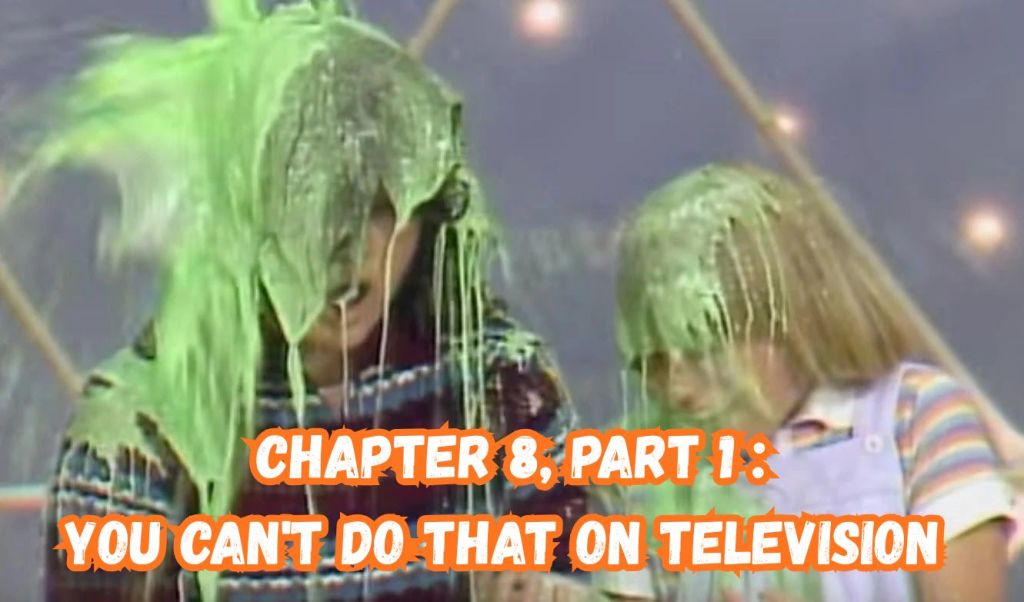
Although water gags were a recurring comedic element, it was the green slime that truly captured the imagination of young viewers watching at home. While the entire show entertained Nickelodeon’s audience, it’s when a bucket of slime poured down on any kid who uttered the phrase “I don’t know” that became standout moments. And it would be this messy, vibrant green substance that would go on to fundamentally shape Nickelodeon’s identity, an identity it desperately needed.
The true origin of slime remains a bit of a mystery. Creator Geoffrey Darby claims the slime gag wasn’t necessarily a planned feature for the show, referring to it as an accident. The inception of slime traces back to an early scene in the series featuring Tim Douglas, a cast member chained up in a dungeon — a setting frequently used in the show’s sketches. In this particular gag, Tim is instructed not to pull one of the chains. Naturally, Tim pulls the chain anyway.
The intended outcome was for a batch of leftover food to be dumped on Tim, simulating the idea that if he triggered the chain, sewage would spill out. To prepare for this messy moment, Darby arranged for all the cafeteria’s leftover food from the day to be scraped from plates and collected into a bucket. There was just one problem: they ran out of time that day to film the scene.
The following week, the production crew prepared once again to film the pivotal dungeon scene. This time, instead of making another request to the cafeteria staff to collect a new batch of leftover food, Geoffrey Darby decided to use the bucket of “slop” that had been left sitting out all week. The prop master immediately saw an issue with this plan: several inches of green mold had formed on top of the week-old food mixture. Demonstrating a “the-show-must-go-on” mentality, Darby, after only a moment’s hesitation, instructed, “Dump it on the kid anyway.”
As a result, Tim Douglas became the first cast member to experience being slimed on the show. He also holds the distinction of being not only the first but the last kid ever to be slimed with a bucket of food that had been sitting out for a week, now topped with several inches of fuzzy green mold.
However, it wasn’t until a few episodes later when the “I don’t know” cue was used to trigger a sliming. Geoffrey Darby recognized the need for a consistent mechanism to set off the slime, some sort of word or phrase that would announce the slime was about to be dumped. He realized that a simple cue — a question the kids could not possibly answer — would prompt them to respond with “I don’t know.” This phrase became the universal signal, and as soon as it was uttered, the audience anticipated what would come next: a cascade of green slime pouring down from above, covering the kid. “That’s all that was,” explained Darby. “It was real simple.”
Geraldine Laybourne kept the origin of slime more secretive. Rather than focusing on how slime was first created, Laybourne emphasized its role within the show, describing it as a humorous tool designed to keep “uppity” cast members grounded. Speaking about the cast, Laybourne highlighted the importance of maintaining their authenticity as “regular kids.” She explained that the children were selected from the Ottawa, Canada area and trained to be kid actors, but the goal was always for them to remain everyday kids rather than being transformed into unattainable television personalities. The periodic sliming of those who became too self-important served as a playful reminder that they were just kids, there to enjoy themselves without developing egos.
Laybourne described the act of sliming as “a funny punishment for being an uppity kid.” However, it is important to note that slime existed on You Can’t Do That on Television before Nickelodeon became involved, suggesting that Laybourne was referring more to the benefits slime provided than its actual origin. Her approach was not entirely without kindness; unbeknownst to her at the time, the kids received an extra $50 whenever they were slimed. So while slime could be seen as a form of punishment, it also came with its own rewards for the cast.
Over time, the recipe for slime evolved from its original, rather unpleasant origins. According to Scott Webb, who served as Nickelodeon’s first creative director from 1983 to 2000, the formula was improved from the initial “slop” that was dumped on Tim Douglas. The refined mixture typically included gelatin, baby shampoo, oatmeal, and green food coloring. The addition of baby shampoo made it easier to wash the slime out of hair, ensuring the messy gag could at least be cleaned up as easy as possible.
Other accounts offer slightly different recipes. Writer Josh Morris recalled that, in later years of the show, the slime was made using cottage cheese mixed with green food coloring. Meanwhile, Geraldine Laybourne, ever playful about the show’s secrets, chose to keep the exact formula under wraps. In an interview, she joked, “It was a secret recipe which I could divulge to you, but then I’d have to kill you.”
All of the gags, jokes, and, of course, the green slime played a significant role in captivating the audience, but it was truly the cast of kids that forged the strongest connection with viewers at home. Roger Price was determined that You Can’t Do That on Television would not mirror the typical television fare of the era, which often depicted perfect families or adorable children who always learned valuable lessons and behaved impeccably. Instead, the show presented an honest and messy portrayal of childhood, emphasizing that no one is perfect and life rarely follows a neat script.
Unlike other shows, there were no tidy moral lessons or moments of precocious wisdom. The kids in the cast didn’t pretend to be flawless or always know the right answer. You Can’t Do That on Television said life is messy, and it’s messy because no one is perfect. This authenticity was refreshing to the audience, and the kids watching at home recognized themselves in the cast, making the show relatable and unique.
Roger Price’s vision for You Can’t Do That on Television centered on authenticity and relatability. Rather than hiring trained child actors, the show sought out regular kids from the local Ottawa high school to fill its cast. By doing so, Price ensured that the children on screen reflected the everyday experiences of the audience at home. The goal was for young viewers to watch the show and immediately recognize themselves and their friends in the characters they saw — kids who looked and acted like their real-life friends.
This deliberate casting choice was pivotal to the show’s appeal. If the audience could see themselves in the cast, it transformed the viewing experience from passive entertainment to something much more engaging. Kids at home wouldn’t just be watching — younger viewers would feel as though they were hanging out with their television friends each week, fostering a genuine sense of connection and belonging that set the show apart from other children’s programming of the era.
Chief among the kids was Christine McGlade, the oldest of the bunch who functioned as a narrator of sorts and unspoken leader of the You Can’t Do That on Television cast for more than six seasons. On the show, McGlade was known by her nickname, Moose — a name she explained originated during her school days. She recalled that the nickname was “based on the fact that I was always the smallest kid in the class. I think [the classmate was] referring to the character in the Archie comics, the giant blonde one, called ‘Moose.’” In reality, McGlade is only 5’2”, and the fellow classmate who gave her the ironic nickname was named Danny Burns.
The show’s writers frequently drew inspiration from real-life details like these, weaving them into the characters portrayed on screen. By incorporating the genuine experiences and personalities of the cast, the show maintained its authentic and relatable tone, making the kids feel true to life for its audience.
All the kids had little to no acting experience and would take a bus from school to the small Ottawa TV studio where the show was filmed. “Saying ‘we were plucked from the schoolyard is metaphorical,” said McGlade. However, this metaphor isn’t too far from the truth. “We went to the station where they put us alone in a studio in front of a camera and asked us questions,” she explained. These interviews, conducted by Price and Darby, were instrumental in determining which children would be cast on the show.
While reading through scripts after school the kids were encouraged to follow their instincts and improvise if they felt the urge to do so. This creative freedom played a crucial role in making the characters feel genuine and relatable, as the improvisation reflected the authentic voices and experiences of real kids. This approach helped the show preserve its commitment to authenticity and ensure that its young stars remained true to themselves and to the audience they represented.
Roger Price selected the kids for the show not based on previous acting experience, but rather on the potential he saw in them. He believed that if the children could develop and gain confidence over the course of a season or two, this growth in self-esteem would be reflected in the characters they portrayed on screen. In this way, young viewers at home could witness the cast members’ personal growth, making it feel as though they, too, were growing alongside their on-screen friends. This mirrored the experience of spending time with real-life peers and contributed to the show’s sense of authenticity and relatability.
Price enjoyed helping the kids recognize what they could achieve, encouraging them to develop both as performers and individuals. He intentionally chose children who looked like the average kid one might see at school or at the mall, rather than aspiring for a cast with traditionally “star” looks. Prioritizing authenticity over appearance was yet another way Price ensured that the cast remained relatable and genuine to the audience.
Laybourne explained the show was to highlight regular kids, and the writers were to create scripts based on what they knew about the cast members. While portraying themselves as characters, the kids in the cast were encouraged to openly contribute to the show. Christine McGlade said You Can’t Do That on Television was the first show produced by kids for kids. Ironically, this was achieved by Roger Price and Geoffrey Darby treating the kids like adults, allowing them to make decisions that would be included in the show. Also, if the kids thought something the writers wrote was corny or not funny, they could say so and the writers would rewrite the scene.
For this reason, the end credits of each show include both the names of the writers as well as a line designated for “the cast and crew” under the written by credit. Involving the kids in the process like this was another way the show was able to connect so well with Nickelodeon’s viewers. The narrative conveyed the authentic perspective of a kid because it was directly informed by the experiences of kids.
In her earlier work as a media teacher working with kids, Geraldine Laybourne learned that kids are more than capable of understanding the process when creating something they would like to watch. “What I learned from working with these kids is that they will lead the way…if you ask kids and involve them in the process, you get a much better product in the end,” she said. Laybourne went on to say that there’s more to children’s programming than cartoons or trying to sell toys. “If we broadened the palette they would come with us,” she said.
This perspective championed by both Price and Laybourne is what ultimately made You Can’t Do That on Television so successful. Laybourne also knew that for the kids to buy into the show, the adults running Nickelodeon and You Can’t Do That on Television first had to meet the kids where they were psychologically. “I often say it’s the most psychologically important show ever done for kids,” said Laybourne. She acknowledged that a show that slimed kids and put them in dungeons would cause many people to furrow their brows and disagree with that statement, but to a kid such extremes make sense.
Everything that happens to a kid can feel like an extreme event. By taking everyday situations and pushing them to absurd levels, the show was able to tap directly into the psyche of its young viewers, communicating with them in a way they could truly understand. As Geraldine Laybourne observed, one of the show’s greatest strengths was its ability to reassure kids that they were not alone in dealing with unfair authority figures — whether those figures were parents, teachers, or other adults in their lives. “What was so great about it was it convinced kids that we knew that they’re all in the same boat,” Laybourne explained, emphasizing the universality of these childhood experiences.
By depicting authority figures behaving in exaggerated and extremely unfair ways, the show sent a comforting message to its audience: maybe their own lives weren’t so bad by comparison. After all, as Laybourne pointed out, no one at home was being thrown into dungeons or forced to eat maggot burgers. Through this unique approach, You Can’t Do That on Television provided both humor and reassurance, helping kids see their challenges reflected — and exaggerated — on screen.
The impact of You Can’t Do That on Television extended far beyond entertainment; the show, along with Nickelodeon, offered genuine hope to children across the country. Geraldine Laybourne commented on how the exaggerated portrayal of adults on television helped kids feel better about their own lives. She explained, “[When adults on TV] were worse than anybody’s parents could ever be, the kid at home ended up feeling better saying, ‘Oh, it’s not so bad for me. I’m doing fine.’” This reassured young viewers that their own experiences, even when challenging, were not as dire as those depicted on the show.
Christine McGlade observed another approach the show took that offered hope to kids by highlighting the choice to feature average, everyday kids who were unafraid to question the odd or unfair behaviors of grown-ups. She noted, “We were telling kids that no one is perfect all the time.” By normalizing imperfection and curiosity, the show validated the feelings and perspectives of its audience, empowering kids to see themselves — and their own questions — as important and worthy. In empowering kids to see themselves reflected on the screen — flawed, inquisitive, and authentic — the show reinforced the idea that their voices mattered, and that questioning the world around them was both natural and valued.
While the kids were encouraged to be average, everyday kids, it was also important to Roger Price that the kids be good enough to be on the show. It still takes acting talent for the kids to pull off being average and ordinary without it looking like they’re trying too hard. To accomplish this, Price brought in drama coach Carole Hay, whose acting style meshed well with the collaborative spirit of the show by encouraging the kids to not only be themselves but be comfortable showing that on camera and around the other cast and crew.
To be continued in part 2 of chapter 8: You Can’t Do That on Television, coming next week!


Leave a Reply