

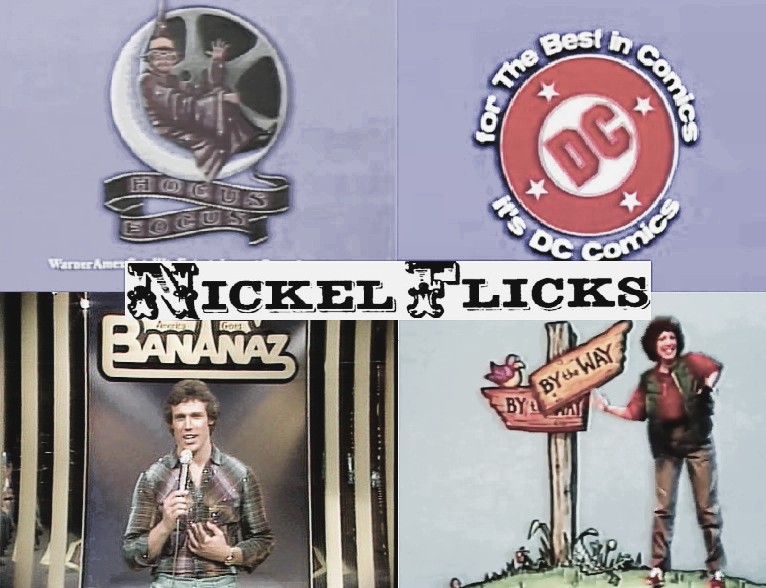
Nickel Flicks showed existing Warner Bros serials from the 1930s and ’40s packaged as programs complete with cliffhangers. Flash Gordon, Rin Tin Tin, and Charlie Chaplin were just a few of the subjects featured on Nickel Flicks. Nickel Flicks “was nothing more than old Warner B movies,” said Joseph Iozzi. “No production cost, just add in program hinges and interstitial material. Voila! A kiddie channel segment!” Such tactics are understandable with a new channel, especially an experimental one that aired commercial free without any sponsorship underwriting.
The wraparound segments for Nickel Flicks were hosted and presented by John Moschitta, Jr., who would later become the fast talking, mustached pitchman for Micro Machines in the 1990s. According to Moschitta, his time on Nickel Flicks was short lived due to complaints from parents who were concerned about the violence featured in some of the serials. Because Nickelodeon touted itself as having quality, non-violent programming for kids, by the time 1979 gave way to 1980, the show was off the air.
Video Comic Books was yet another cheap show created quickly to produce content for Nickelodeon. Because Warner owned DC comics, they were able to tap into the DC library to give kids a show featuring their favorite superheroes like Batman, Superman, or the Flash. But the show wasn’t an animated series, that just wasn’t in the budget for Nickelodeon at the time. Instead, Video Comic Books simply displayed pages from comic books that were read aloud by voice actors. The show was given some energy by incorporating movement such as panning across a page, zooming in and out, and having music and sound effects playing in the background of each story.
Video Comic Books was a colorful show by default, thanks to the comic books on the screen. It was the only show on the network at the time that didn’t feature a human host or offer some sort of moral or social message. In a way, because kids could read along with some of the speech bubbles on the pages, Video Comic Books served as a break of sorts from merely watching television. The show served as a cheap and speedy way to fill programming slots for the channel, capitalizing on the growing popularity of children’s books that could be enjoyed both by reading along and listening to audio tapes.
America Goes Bananaz was a hybrid, teenage version of the popular variety show format, merging inspiration from classics like The Ed Sullivan Show and American Bandstand. The show’s concept originated on Warner’s QUBE system in Columbus, Ohio, where it was originally titled Columbus Goes Bananaz. With the national launch of Nickelodeon, the show adapted to a broader audience and the title was updated to America Goes Bananaz. Randy Hamilton served as the host, guiding the program through its transition from a local Columbus offering to a nationwide platform.
America Goes Bananaz was designed specifically for young viewers, tackling a broad array of topics relevant to teenagers, such as birth control, drug awareness, college preparation, and financial management. While the show addressed these serious issues, it also balanced the tone by incorporating lighthearted segments like dancing, pie-eating contests, talent competitions, and appearances by guest stars from movies and television. This blend of informative discussions and entertaining activities helped the show appeal to its teenage audience.
Among Nickelodeon’s original programs at launch, America Goes Bananaz stood out as particularly engaging for young people. The show’s format was innovative for its time, featuring a variety talk show approach geared towards viewers under the age of 18 — a concept rarely seen on television then. According to Vivian Horner, cable television offered a unique opportunity for more experimental programming compared to traditional network TV. As she explained, cable programming had to respond directly to its audience: “With cable, you’re ultimately answerable to the audience. You find things to please the audience and give them their money’s worth.” This philosophy was clearly reflected in America Goes Bananaz, which embraced experimentation and fostered a sense of community among its viewers.
One of the show’s distinctive elements was its in-studio audience, which participated in conversations and activities. This interactive environment allowed young viewers watching at home to see their peers discuss common concerns and experiences. By providing relatable perspectives and collective engagement, America Goes Bananaz helped young audiences feel connected and less isolated with their own challenges. Most importantly, the show’s unpredictable and lively atmosphere contributed to its appeal, exemplifying the fun and adventurous spirit that Nickelodeon would soon learn to cultivate in its programming.
By The Way was yet another packaged show that featured acquired short films, mostly animated. There was no overarching theme to the show, which probably explains the vague description in the October 12, 1979 edition of the Times Union newspaper. The description read like this: “By The Way is a free-wheeling, wide ranging program for children ages 7 to 12 structured to make kids aware of the ever-changing issues to be dealt with along the path of life. Through animated and live action films and a character created especially for the show named Josie, By The Way explores children and the world around them. It looks at their problems and adventures, the real world and the fantasy world, what came before and what is yet to come.”
The framing device showcased a character named Josie, an adult human character (played by Andrea Helman) who appears to be hiking or camping in a still-frame, animated forest. This is another bare-bones production technique that again reflected Nickelodeon’s meager budget. These framing segments aren’t thematically connected to any of the shorts that play before or after them, they instead simply serve as a very loose grounding device to give the show some sort of static environment. By The Way only lasted about a year on the network, and at some point in 1980 it was off the air.
Hocus Focus was another show that featured previously produced films that Nickelodeon acquired from companies such as Bernice Coe, Encyclopedia Britannica, Xerox and Macmillan. The topic of these films varied greatly from animated shorts to footage of animals in nature and, like Nickel Flicks, was bookended with a framing device. The framing segments were produced by Nickelodeon and featured a medieval wizard named Kryspen (played by Pinwheel puppeteer Brad Williams), who had been transported to modern times and used videos to learn and explain how the modern world works. The show also featured Pinwheel puppeteer Jim Jinkins. One Nickelodeon promo reel from 1980 refers to Kryspen as a “foreign exchange student from the middle ages,” and says, “using fascinating films, Kryspen explains the magic of the modern world.”
Another significant factor behind Warner Amex’s reliance on inexpensive programming was the restrictive regulatory environment that the cable industry faced during this period. These constraints were largely a consequence of persistent lobbying by major industries that felt threatened by the rise of cable television. Among these were theater owners, newspapers, and telephone companies, all of whom feared that cable might erode their established sources of revenue or influence.
As Gustave Hauser explained, newspaper proprietors worried that cable television could one day offer classified ads, potentially diminishing the newspaper revenues. At the same time, telephone companies were apprehensive about the emergence of a second communications wire being installed in homes — a direct challenge to their longstanding monopoly, especially since services like HBO initially distributed their programming via telephone lines when they launched in 1972.
The result of these combined anxieties was the implementation of government regulations targeting the cable industry. According to Hauser, these measures were primarily a response to “the theoretical concerns of potentially competitive businesses,” rather than any proven threat. He argued that a more collaborative approach could have been taken: if telephone companies had permitted cable companies to lease their infrastructure, both industries might have benefited from mutual oversight and shared interests.
However, the reality was quite different. Stringent charges and limitations imposed by the telephone companies made leasing their facilities unattractive for cable operators. As a consequence, cable companies were compelled to invest in developing their own independent infrastructure. Ironically, these moves not only increased costs but also resulted in cable emerging as a genuine and formidable competitor — one beyond the control of the incumbent telephone companies.
Another hinderance the cable companies faced was rate regulation and price controls enforced by local governments, thus limiting financial gain. To help offset this limited income, Warner asked cable operators to pay five cents a month per subscriber for Nickelodeon. “National distribution was negatively affected for years as cable operators struggled to get a five cent rate increase approved by local authorities,” said Hauser. An example of this was United Cable Television’s cable station in Plainville, Connecticut. The station served 27,000 subscribers and would be charged 10 cents per household reached to carry Nickelodeon. James Dovey, the station’s general manager, said the extra $2,700 monthly charge wasn’t (at the moment) cost effective for his station. As a result, that cable provider did not carry the channel.
While Warner Amex navigated regulatory hurdles and negotiated with local authorities to secure Nickelodeon’s inclusion on more cable systems, another challenge persisted: the network faced a significant shortage of original programming. The promise of a dedicated children’s cable channel was appealing, and Pinwheel continued to be a standout, innovative, and popular offering — largely by default, as there was little else to engage or entertain young viewers.
Reflecting on these early days, Joseph Iozzi observed, “There was no network, there was barely an inkling,” highlighting the lack of a cohesive identity or robust lineup for Nickelodeon at the time. Iozzi noted the company’s willingness, for better or for worse, to act decisively when opportunities arose; if Warner decided to launch a national children’s network, the process moved very quickly. This approach aligned with the leadership style of Gustave Hauser, an innovator who pursued new ventures without hesitation.
Iozzi further explained that the speedy launch of Nickelodeon leaned heavily on a content strategy that relied on utilizing existing intellectual property — specifically, the vast library of Pinwheel episodes produced in Columbus and the broader Warner film catalogue. “It was always a matter of utilizing the intellectual property already in the can,” Iozzi said. By repurposing this existing material, Nickelodeon was able to maintain a presence on air despite limited resources for new productions, underscoring both the creative constraints and resourcefulness that characterized its formative years.
Iozzi may have been on to something. The precise nature and intended purpose of Nickelodeon appeared to be up for debate. Pinwheel was well established, an original program approved by parents and enjoyed by kids. But the rest of the hours in the day appeared to lack cohesiveness, showcasing a schedule of random program options akin to throwing spaghetti against the wall to see what sticks.
Vivian Horner was realistic about Nickelodeon’s standing at the time, saying “The object is not to compete with the commercial networks but to provide an alternative.” Horner recognized that Nickelodeon was not equipped to challenge the broadcast networks or other well-established cable channels in terms of resources or popularity. Rather, her vision for Nickelodeon centered on creating a space where children could genuinely enjoy what they were watching. The success and sincerity of Pinwheel stood as a testament to Horner’s commitment to providing meaningful programming for kids.
Horner was aware that cable needed to differentiate itself from the traditional over the air networks. She also saw the potential cable had to create a higher quality of programming. “Cable isn’t television. It’s something else,” said Horner. “Television does what it does very well, in return for considerable revenues that don’t necessarily depend on the quality of the programming.” Horner was emphasizing that “television,” meaning the established, over the air networks, were supported by companies who bought advertising time during their programs. The big advertising dollars allowed the networks to market themselves and their programs. Because the big networks were on television first, the advertisers knew a large, built in audience was already there to be reached.
As for cable, it wasn’t available over the air and had to be wired into people’s homes, depending on a subscriber base to a cable provider to fund each channel’s operating budget. The quality of programming on these cable channels therefore had to offer something of value to entice potential viewers to tune in. Realizing this scenario, Horner viewed Nickelodeon as a retailing business: the idea had to grab a consumer’s attention, and the product had to sell itself to viewers.
On the other hand, Nickelodeon’s vice president at the time, Scott Webb, took a more dollars and sense, albeit cynical, approach to the network’s responsibility, saying “In those days, Nickelodeon wasn’t about kids, it was about cable bills.”
This sentiment can be seen and heard in Nickelodeon’s first on air promo, created by Joseph Iozzi. As an old nickelodeon film strip flickers in front of a child, a voice over from radio announcer Phil Tonken says “Introducing Nickelodeon, children’s programming that’s fit for children. Fourteen hours of programming a day, seven days a week that will make them wonder, laugh, ponder, and think. We took everything that was wrong with children’s television and got rid of it. We kept everything that was good about it and made it better. The result is Nickelodeon, The Young People’s Satellite Network.” This voiceover is clearly a call to parents and cable operators promising a worthwhile investment. It’s also vague and very self-assured for a new experimental network. This is reasonable considering Warner Amex was seeking to sell the network; however, the lofty statements presented in the promo set high expectations that would prove challenging to meet.
While Nickelodeon’s leadership may have established a vague vision for the network during its inaugural year, one of “quality programming for children,” a fundamental question remained: could that vision truly be brought to life in the absence of a distinct identity? For the network to succeed, it needed more than just a simple idea — it required creative cohesiveness that would resonate with children, and to a certain extent their parents. This disconnect between vision and identity emerged as a central challenge for Nickelodeon in its earliest days, illustrating that having a guiding purpose is only valuable if it can be translated into a compelling and consistent presence that could connect with a young audience.
Stay tuned next week for chapter 5!


Leave a Reply