

“I conceptualized Nickelodeon and got it off the ground,” said Pinwheel creator and producer, Vivian Horner. Coupled with Hauser’s idea of quality children’s programming and tapping Horner for the task, this assertion is largely undisputed, as the success of Pinwheel on QUBE in Columbus laid the essential groundwork for the creation of a national children’s channel in 1979. Without the positive reception and proven format of Pinwheel, the launch of Nickelodeon as a nationwide network would not have been possible.
But the naming of the channel is a different story. Despite the undeniable impact of Horner’s vision in bringing the channel to life, the origin of the Nickelodeon name is less certain. The question of who first suggested the name is a matter of debate, with two different individuals or groups each claiming credit.
Joseph Iozzi worked as a creative consultant for a corporate communication and marketing agency called Comtomark. The company successfully aided in the launch of The Movie Channel and now was being called upon to come up with a name for a new children’s programming network being launched by Warner Cable. Iozzi said “anyone in the agency that could hold a pencil” was asked to contribute a possible name. A list of 150 names, including The Savoy Channel and The Rainbow Network, were handed in to Warner for consideration. Iozzi claims to have contributed the name Nickelodeon, saying it seemed like a natural option. “The Nickelodeon was a turn of the century device for dispensing entertainment,” Iozzi said “The sound of the word was nice and rolled off the tongue easily.”
Gustave Hauser backs up Iozzi’s claim of a submitted list containing over 100 names, saying he “selected the name Nickelodeon from a list presented by professionals.” Hauser doesn’t name where exactly this list from “professionals” came from, but it’s fair to assume he was referring to a marketing agency. However, Pinwheel producer Sandy Kavanaugh said that Vivian Horner asked her and fellow associates to come up with a list of possible names for the network as well. “I came up with a list and Nickelodeon was my favorite,” recalled Kavanaugh, admitting she wasn’t thrilled with the name. Much like Iozzi, Kavanaugh did have a similar fondness for the word. “It was whimsical sounding, though. It had a fun lilt,” she said.
It’s impossible to say with absolute clarity who did in fact come up with the name Nickelodeon. Was it Iozzi and his list from Comtomark, or was it Kavanaugh and her list? Is it possible they both submitted lists with the same suggestion that found their way to Hauser? Iozzi is confident the name came from him, saying “The name Nickelodeon was never used or mentioned in any context until I named the channel in 1979.” On the other hand, Kavanaugh has someone else who says it was her who named the network. “The name Nickelodeon came from Pinwheel producer Sandy Kavanaugh,” said George James.
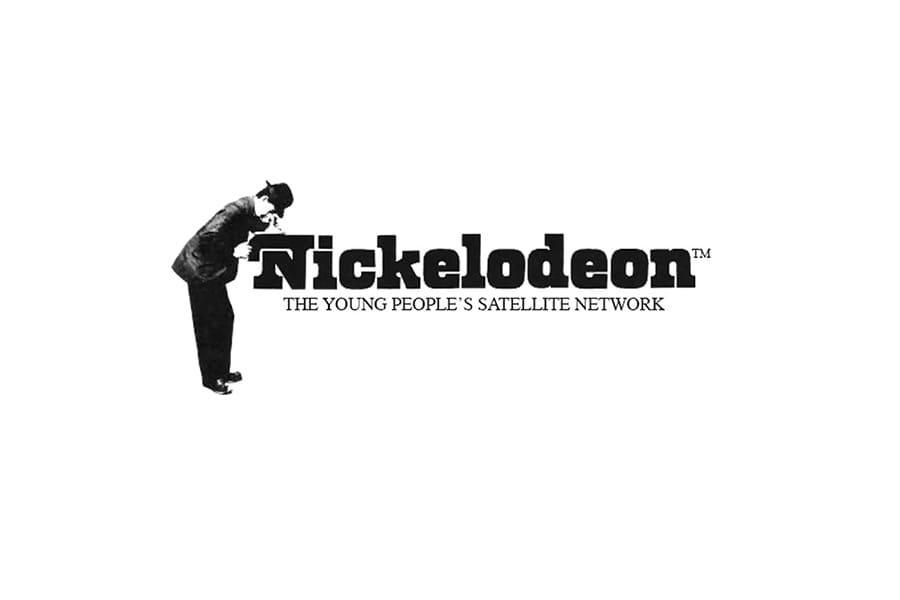
Although his claim proposing the name of the network may be in dispute, Joseph Iozzi can lay claim to Nickelodeon’s first logo. For inspiration Iozzi leaned on the name Nickelodeon, taking a literal approach to the logo’s design. “The graphic was a line drawing of a turn of the century man in a bowler hat peering into a Nickelodeon machine with his arm ready to crank the machine,” said Iozzi. The machine was attached to the N in Nickelodeon, supplying the visual that Nickelodeon was the entertainment being dispensed.
Being aware that the image of a grown man on the logo for a children’s network probably wasn’t the best approach, Iozzi said he wanted to replace the image of the man with that of a little boy wearing an English cap and standing tip-toed looking into the Nickelodeon. “We were always pressed for time, and I never got around to revising the original logo as I planned,” Iozzi explained. Not only did he never get around to altering his original logo design like he wanted, but the man in the bowler hat image he used was considered stock art and couldn’t be trademarked. Iozzi will always be able to say he created Nickelodeon’s first logo, but because of these missteps the logo would only last a couple of years.
With the selection of a name and logo, the next critical step for Nickelodeon was establishing a system to deliver its programming to television sets nationwide. Gustave Hauser, then chairman of Warner Cable, possessed a unique background in satellite communications — a skill set that would prove invaluable throughout his career.
Hauser’s expertise in satellite technology dated back to his tenure as counsel to the International Security Agency at the Pentagon in 1957. That year marked a significant milestone in space history, as the Soviet Union successfully launched Sputnik, the world’s first artificial satellite, into orbit. Sputnik circled the Earth every 98 minutes, transmitting radio signals that could be received by anyone with the appropriate receiver.
The launch of Sputnik raised pressing questions among Americans about the implications of objects orbiting above other countries’ territories. Hauser recalled that people began to ask, “What does all this mean? What are our reciprocal rights to orbit an object over another country’s territory?” With no established legal precedents for objects in space, the Pentagon tasked Hauser with addressing these concerns.
To tackle the issue, Hauser drew upon the law of the sea as an analogy, applying its principles to the emerging domain of space. He wrote what he believes was “the first paper that the Defense Department originated assessing international legal rights and obligations concerning objects orbiting in space.” This early work would later inform Hauser’s strategic decisions in leveraging satellite technology to expand cable television networks, including Nickelodeon.
In 1972, Gustave Hauser served as the executive vice president of Western Union International, a company specializing in telegram and telex communications. That same year, Western Union International made a significant technological leap by installing a satellite ground station at the airport in Beijing, China. This station was used to transmit images back to the United States from President Richard Nixon’s and Secretary of State Henry Kissinger’s historic visit to China, marking a pivotal moment in global communications.
Meanwhile, 1972 also saw Charles Dolan and Gerald Levin establish Home Box Office, or HBO, which became the nation’s first pay-TV network. HBO would further shape the television industry in October 1975 by using satellite technology to broadcast live the “Thrilla in Manila,” the third heavyweight boxing match between Muhammad Ali and Joe Frazier, directly to its subscribers in the United States.
The impact of satellite distribution continued to grow. In 1976, Ted Turner transformed his Atlanta-based station, WTBS, into the country’s first “superstation” by using satellite technology to broadcast nationwide. By 1979, while working at Warner Cable, Hauser recognized the increasing adoption of satellite distribution among cable television networks. He saw satellite technology not only as an innovative solution but as the inevitable path forward for delivering content to a growing audience of cable subscribers.
To distribute their programming to viewers’ homes, cable companies adopted a system centered around satellite technology. Rather than transmitting signals directly over traditional terrestrial methods, they leased access to satellite transmission facilities. This arrangement allowed them to send their programming signal from an uplink station — specialized facilities equipped with powerful transmitters — up to a communications satellite orbiting the Earth.
Once the signal reached the satellite, it was then broadcast back down to Earth, where it was received by cable system head-ends. These head-ends were large satellite dish receivers designed to capture the signals sent from multiple satellites. After collecting the programming signals, the head-ends would sort them by channel and retransmit them along the network of cables connecting to individual households, ultimately displaying the desired programming on subscribers’ television screens.
When Warner sought a distribution method for Nickelodeon, they utilized this satellite-based system. However, instead of merely leasing programming rights on a satellite as many competitors did, Gustave Hauser took a different approach. He successfully arranged to purchase the rights to use an existing satellite for Warner’s distribution needs from an unexpected source. Hauser explained: “I learned that the then famous televangelists Jim and Tammy Faye Baker owned appropriate rights on an existing satellite, and I went to meet them at their huge television studio church in North Carolina to negotiate a purchase.” He would go on to say how polite everyone was and how they all said “God love you brother” as he walked by them. But Hauser then joked that “it was cash, not love, that persuaded the televangelists to part with their heavenly satellite rights and to help me launch Nickelodeon for the world’s children.”
The satellite ground station, or uplink station, that Warner would use to transmit its programming signal up to the satellite in orbit was located at the WIVB-TV studios on Elmwood Avenue in Buffalo, New York. The first programming images on Nickelodeon, which launched April 1, 1979, ran through state-of-the-art video tape playback machines located in a small building next to the station before being converted to satellite signals. This uplink was not only the distributor for Nickelodeon at the time but for the Movie Channel as well, and for a few years during the mid to late 1970s it was the only uplink in the northeast portion of the country that provided programming to satellites that were then beamed around the world.
The rapid growth of the cable industry was apparent by 1979, with satellite delivered cable services on the rise. Channel counts were getting larger, including pay-TV channels such as Showtime, HBO, The Movie Channel, ESPN, and C-SPAN. Forbes magazine called the growth “cablemania,” and Warner wanted in on the action. The only problem was the company’s eagerness to be a major player would require a large amount of capital. “This was going to be bigger than Warner Communications could handle,” said Hauser. Simply put, Warner Communications didn’t want and couldn’t have Warner Cable’s debt on their balance sheet.
To address the substantial capital requirements needed to enter the rapidly growing cable industry, Warner initiated negotiations with American Express to form a partnership. Recognizing the potential for innovation and profit, American Express was attracted by the interactive capabilities of Warner’s pioneering QUBE system. Within a year, the joint venture known as Warner Amex was established.
Gustave Hauser, reflecting on the partnership, noted that American Express saw significant synergies with its existing merchandising and credit card operations. The company was eager to diversify its business portfolio and viewed cable television as a promising avenue for expansion. A key incentive for American Express was the integration of its credit card services with QUBE’s interactive features, envisioning a system where Warner Amex subscribers could conveniently order products directly from their television screens using their American Express cards.
The newly formed partnership between Warner Amex and the owners of the WIVB studios in Buffalo were unable to agree on a long-term arrangement for the continued use of the satellite uplink facilities. As a result and now supported by increased capital following the Warner Amex joint venture, Warner Amex made the decision to relocate Nickelodeon’s signal from Buffalo’s WIVB studios to the Matrix Studios in Manhattan. This move also facilitated the subsequent launch of MTV from the same location.
The influx of financial resources from Warner Amex had a significant impact on Nickelodeon’s flagship program, Pinwheel. Production of new seasons, which had previously taken place in Columbus, Ohio, was transferred to the spacious and modern Matrix Studios in Manhattan in 1980. With this transition, Pinwheel benefited from a rebuilt set and an upgraded studio environment.
The move to Manhattan also enabled the addition of several new human cast members to enrich the show’s storytelling. Among the newcomers was an artist named Kim, portrayed by Arline Miyazaki. The cast was further expanded by introducing two new puppet characters, an elderly couple named Sal and Smitty, who operated a fictional newspaper called The Daily Noodle. These characters were played by Betty Rosek and Dale Engel, respectively.
Franci Anderson, who played a storyteller named Franci and voiced the Wonkles and Spiderbelle, decided to stay in Columbus when the production moved to New York. Because her characters were retired, new puppet characters were created for the ensuing season including Admiral Bird (Craig Marin) and the Hobo Bugs brother and sister (Marin and Olga Felgemacher). Missing in the cast would be CC Loveheart, who cited contractual issues and an urge to move on to speaking roles as her reason for not returning to Pinwheel.
Alongside the introduction of new human and puppet characters, production was further enriched by acquiring a collection of short films from Coe Film, a distribution company established by Bernice Coe in 1971. Coe Film was dedicated to showcasing the work of independent filmmakers on television, and the shorts purchased were thoughtfully integrated into the program. These films served as interludes between the various stories and happenings centered around Pinwheel House, blending with the adventures of the puppets and human cast members.
With the addition of these diverse short films, an expanded ensemble, and increased financial investment, Pinwheel underwent a significant transformation. The show now featured a more polished appearance, higher production values, and a richer, more immersive world for its young audience to enjoy. “It was a much more professional full-blown production than the experiment in Ohio,” said George James.
No longer would there be confusion between the name of the show and the name of the channel. The revamped Pinwheel ran on Nickelodeon as hour-long episodes shown in three to five hour blocks. But with 13 hours of programming to fill every day, Nickelodeon needed mor than just Pinwheel to fill up its schedule. Warner dug into its own expansive film vault, Warner Bros. Pictures, to create anything resembling a program. In addition to Pinwheel, the programs on Nickelodeon at the time of its launch were Nickel Flicks, Hocus Focus, Video Comic Books, America Goes Bananaz, and By The Way.
Chapter 4 coming next week!


Leave a Reply