

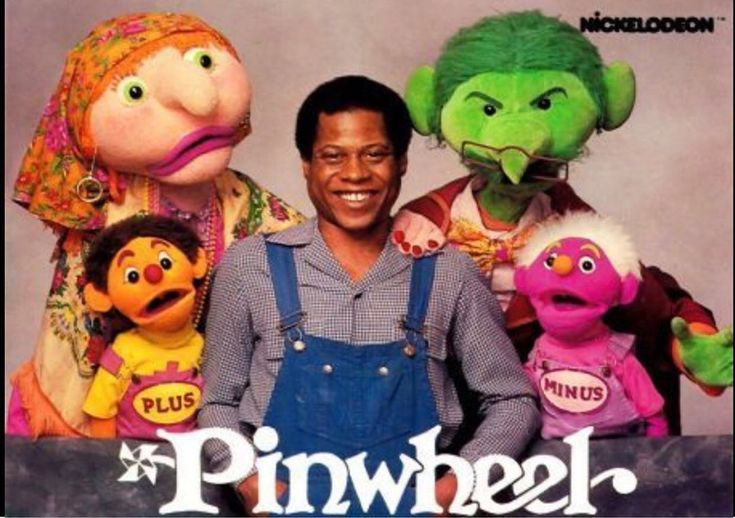
To help her craft such programming, Vivian Horner enlisted the help of her colleague Sandy Kavanaugh, another Children’s Television Workshop alum. The two came up with an idea called Pinwheel, which would be produced in the QUBE headquarters in studio B in Columbus. The final concept for Pinwheel was formulated from research done at the Ontario Institute for Studies in Education. This research involved the participation of children, parents, and teachers.
According to Ronald Castell, QUBE channel C-3, which aired Pinwheel from 7am to 7pm, was “the only channel in the world geared to the interests and short attention span of preschoolers.” Castell goes on to speak of the revolutionary format of the show, saying there is no beginning, middle, or end. With each segment of the program running an average of only three minutes, children can tune in at any time and won’t have to wait long for a new segment to hold their attention.
Pinwheel, much like Sesame Street, was a live-action program that featured an engaging mix of human and puppet characters. All the action was set in and around Pinwheel House, an old brick Victorian house perpetually bathed in sunshine and blue skies. The house served as home to many residents, but was owned by Aurelia, a puppet fortune teller who adds a motherly presence to the setting.
Each episode of Pinwheel incorporated numerous songs and games designed to teach important lessons in a subtle and entertaining manner. The show emphasized values such as sharing, listening, problem solving, communication, and getting along with others, weaving these themes seamlessly into its content.
In addition to the interactions between human and puppet characters, the show regularly featured a variety of short films. These segments ranged from scenes of children going apple picking, learning when it is appropriate to scratch an itch, to a child waiting for his father to return home from work. Importantly, these short films were independent productions, not created by the QUBE studio; instead, they were leased from outside companies. One notable example was an animated short that introduced American audiences to Paddington Bear.
Collectively, these elements made Pinwheel a vibrant children’s variety show. Its episodes were filled with diverse, entertaining, and educational segments, all crafted to engage young viewers and support their development through enjoyable and meaningful experiences.
The use of puppets was a popular approach in children’s television, as evidenced by the widespread influence of Sesame Street and the growing popularity of Jim Henson’s Muppets. Puppetry not only brought vibrant characters to life but also provided a practical solution for expanding the cast without the added expense of hiring numerous actors. Despite QUBE’s budget for Pinwheel being only a fraction of what was available to those major productions, Brad Williams successfully created a cast of colorful, kind-looking puppets that were as distinct in personality as they were in appearance.
This clear differentiation among the puppets was crucial, as it allowed young viewers to easily recognize and distinguish between the various characters. By observing these distinct personalities interact, children could watch the characters work together and learn to get along — one of the fundamental lessons emphasized throughout Pinwheel.
The cast of puppets on Pinwheel was marked by clear visual and personality differences, making each character memorable and easily recognizable for young viewers. Among the most notable were Luigi O’Brien and Ebenezer T. Squint, both portrayed by Brad Williams. Luigi O’Brien, an easy-going, orange, Italian vegetable and fruit stand owner, contrasted sharply with Ebenezer T. Squint, a prickly, green prankster and magician.
In addition to Luigi and Ebenezer, the puppet ensemble included two young brothers, Plus and Minus. Plus, played by Brad Williams, was orange and known for his optimistic outlook, while Minus, portrayed by future Doug creator Jim Jinkins, was purple and more pessimistic.
The group was rounded out by a variety of other unique puppet characters. Molly Mole, brought to life by Olga Felgemacher, was a storytelling mole who contributed narrative elements to the show. Craig Marin played Admiral Bird, a clever, red bird, and Silas, an elderly snail who moved slowly and appreciated life’s simple pleasures. Marin also collaborated with Felgemacher as Lulu and Herbert, the Hobo Bugs, bug brother and sister with distinct personalities. Franci Anderson portrayed Spiderbelle, a purple spider, as well as a collection of otherworldly marionette creatures known as the Wonkles.
The diversity among the puppets on Pinwheel heightened the need for the human characters to be equally distinct and engaging. Since the program’s primary audience was children, it was essential that the human cast appealed directly to them, fostering connection and interest. The show’s creators recognized that the human presence should complement the vibrant puppet ensemble, ensuring that every aspect of the show captivated its young viewers.
Among the human characters, Jake stood out as the most vital. He played a central role, responsible for many of the musical segments, which were integral to the show’s educational and entertainment value. The creators sought someone authentic, genuine not only in their approach to educating children, but also in their capability to do so effectively. Jake needed to possess musical talent, curiosity, and an artistic touch, able to impart lessons that felt natural and never heavy-handed.
For this crucial role, Horner, Kavanaugh, and QUBE selected George James, whose background and abilities perfectly matched the needs of the show. James’s musicality and genuine demeanor enabled him to connect with and teach children in a way that was both gentle and impactful, embodying the core values Pinwheel aimed to deliver through its programming.
James first heard about the opportunity to work on Pinwheel through his friend John Simon, a successful music producer who worked with such bands as Simon & Garfunkel and Blood, Sweat & Tears. Simon heard that Warner Communications was looking for a talent with an ethnic background to assist in the development of a children’s show and thought James would be a good fit for the project. “They were looking for someone who could act and write songs as well as produce the songs and music for the show,” said James. “[Simon] gave them my name, and I received a call asking if I would like to audition.”
James was instructed to compose a song that he would then perform at the Warner offices at Rockefeller Plaza in New York City. He wrote five songs he referred to as “The Dream Songs,” with each song having the same melody but offering different lyrics about being different types of animals. “After about two days I got a call asking if I would come to their offices to discuss being part of this project,” said James. James knew the name of the project was Pinwheel, but beyond that he was unsure of exactly what Pinwheel would be, and he left the meeting looking forward to taking part in the creative process.
With his father being a former Broadway actor as a child and his mother often taking him to the symphony, movies, and theater, George James was exposed to the arts at a very young age. Although a shy child, James felt a need to express himself and by age seven he was playing the trumpet and performing in plays and reciting poetry. What seemed to fascinate him most was music and its combination with telling a story. “I remember seeing West Side Story and The King and I and being totally fascinated and captivated by the power created by the marriage of music, words, and story. How these elements when artfully put together could make one laugh, cry and feel something deeply universal to all who witnessed,” said James.
James continued to nurture his passion for the arts by attending Hofstra University, where he concentrated on understanding the impact of voice and music in theater. His academic focus was shaped by an early fascination with how music and words could merge to evoke emotions that were “deeply universal,” a feeling that had captivated him since childhood. By immersing himself in these studies and drawing on his established musical background, James developed a skill set ideally suited for his eventual role as Jake on Pinwheel.
James gave thoughtful consideration to the field of children’s entertainment, always mindful of the importance of respecting his young audience. He was determined never to speak down to children, and instead, he leveraged his expertise in voice and music to craft an approach that was both straightforward and gentle. His method ensured that children could easily grasp the lessons and messages he conveyed, all while being treated with genuine respect and understanding. “I…saw Jake and Pinwheel as an opportunity to present myself and the music with a sense of respect and integrity of the audience,” James said. He also stated that his character on Pinwheel was essentially him just being himself. In fact, Jake is his middle name.
Another human character on the show was a mime named Coco. Much like George James’s approach with the character Jake, the development of Coco was entrusted to the actress who portrayed her. Caroline Cox, professionally known as CC Loveheart, came to the attention of Pinwheel producer Sandy Kavanaugh while performing in a two-person mime show in New York City. Impressed by her performance, Kavanaugh invited Loveheart to consider creating and developing a mime character for what was then called Pinwheel House, which was still in the developmental stage.
Loveheart accepted the challenge and took on both performing and writing responsibilities for Coco. During the first two seasons of Pinwheel, she created and performed 96 sequences featuring her original mime character. This allowed Loveheart to shape Coco’s personality and presence on the show, contributing significantly to the diversity and depth of the human cast alongside the imaginative puppet ensemble.
While George James wrote and composed his own songs, his dialogue was largely written by the writers. But how to write for a non-speaking, physically expressive character such as a mime eluded them. So, Kavanaugh gave the task of writing for Coco to Loveheart. “I wrote almost all the skits that I performed because the writers did not know how to write for a mime,” said Loveheart. “Writers use words, mimes do not, so I was also hired as a writer.” It benefited both Loveheart and the Pinwheel production greatly that Loveheart had not only performed in but also written several mime shows, beginning with a show called Friends of Mime.
Growing up in Las Vegas, Loveheart, spent her formative years with aspirations of becoming a dancer. She performed in local venues, including well-known casinos and hotels such as the Sahara Hotel, honing her craft and stage presence from an early age.
Seeking to further her development in the performing arts, Loveheart moved to New York City, where she dedicated herself to the study of movement. She trained under Moni Yakim, a respected and demanding French instructor at the Juilliard School’s drama division. Notably, Yakim’s surname was originally “Yakin,” but a misspelling during an early U.S. performance led to the adoption of “Yakim” for the remainder of his career.
After becoming a mother, Loveheart sought a way to regain her physical fitness and reconnect with the performing arts. She enrolled in a mime class at a community college in upstate New York, motivated by the desire to “get back in shape.” This decision would prove to be transformative for her career. During the course, her instructor recognized her talent and offered her an opportunity to perform alongside him in New York City. “The teacher of the class asked me to perform with him in New York City,” said Loveheart. It was during one of these performances that Sandy Kavanaugh, producer of Pinwheel, noticed Loveheart’s abilities and subsequently invited her to join the Pinwheel team. This chance encounter set the stage for Loveheart’s influential role in the creation and development of the beloved mime character, Coco.
Loveheart developed the character of Coco around the idea of entertaining and informing the child viewers. Her aim was to make Coco “available and loveable for kids of varying ages,” and to connect with them through movement that conveyed innocence and playfulness. Loveheart didn’t want the loveable innocence of the movement to be overshadowed by the traditional white mime face, something kids are often frightened by. To soften the look, she added hearts drawn onto the cheeks, large false eyelashes, and a paler lip color. “I would get in front of the camera and look at the monitor to see if the look was friendly, appealing and not scary,” she said. All this attention to the delicate and childlike look, personality, and movements of Coco were grounded in the need to be physically in shape while filming. “I was required to be an ‘athlete’ in that often many takes were required, so I had to be very strong physically, in order to repeat the mimes required,” she said.
During the development phase of Pinwheel, the creative team convened regularly at the Warner offices, sometimes meeting as often as four times each week. These sessions played a crucial role in shaping the show’s identity and direction. At this early stage, the project was often referred to as Pinwheel House, a name that reflected its initial conceptualization. As the development progressed, the title was eventually shortened to just Pinwheel.
The primary objective of these meetings was to thoroughly develop the show’s characters and solidify its overall creative vision. Through extensive discussion and collaboration, the team worked to ensure that each character was well-defined and that the series would take a clear and purposeful direction.
Rather than following the direct educational model popularized by shows like Sesame Street — which frequently centered on teaching specific academic skills such as counting or learning the alphabet — Pinwheel chose to take a more understated and holistic approach to children’s learning. The program emphasized subtle yet essential lessons, focusing on themes such as building relationships with others, developing problem-solving abilities, and encouraging self-expression.
George James reflected on this philosophy, stating, “I think that it would be correct to say that it was the original intent for Pinwheel to teach simple life lessons and to have a positive message in general.” From the onset, the producers and writers were intentional about differentiating Pinwheel from its contemporaries by prioritizing these broader life skills over rote academic concepts.
Despite this divergence in educational focus, Pinwheel successfully captured the spirit of inclusivity and warmth that made Sesame Street so beloved. The show’s creators were committed to fostering an environment that was both welcoming and supportive, making every child feel valued and included, while also providing meaningful guidance through gentle exploration of universal life lessons.
The designation “Pinwheel” is often a source of confusion, as it is unclear whether the term refers exclusively to the television program or also encompasses the channel on which it aired. Both answers are technically correct. Pinwheel was the only show that aired on QUBE channel C-3, running commercial-free all day from 7am to 7pm. So, while Pinwheel, referring to Pinwheel House where the puppets and humans lived, was the name of the show, it makes sense to call the channel Pinwheel as well considering Pinwheel was the only content aired on that channel. In fact, QUBE vice president of marketing, Ronald Castell, referred to Pinwheel as a channel in 1977 and talked about it more as a “concept” and “format” instead of strictly as a show. So, while the show came first to fill the children’s programming on channel C-3, it’s natural to blend the show and channel together and refer to them both as Pinwheel and the Pinwheel channel.
QUBE proved to be a success in the Columbus, Ohio area, with channels dedicated to niche programming like sports, news, movies, and children’s entertainment being the ultimate ingredient to success. However, QUBE (and therefore Pinwheel), was a loss leader for Warner, meaning the true value of the product wasn’t being recouped. Gustave Hauser said the QUBE experiment was never designed to grow by simply staying in the Columbus area. True growth would only come from expanding the system into other markets across the country.
This expanding not only referred to the channels, but also to the technical components and interactive abilities of the QUBE system. The outcome in Columbus made this possible, allowing Warner to gain approval to introduce cable systems in markets throughout the nation. The willingness of cable operators to allow Warner’s programming to appear on their airwaves allowed Hauser to deem QUBE a success, stating “The basic QUBE concept was vindicated.”
A few channels within the QUBE package were also experiencing success of their own, specifically the music channel, the movie channel, and the children’s programming channel. Pinwheel was a hit with parents, who over the course of the first year grew to trust the program’s content with their children. And while the budget was low, Pinwheel made the most out of what they had, creating lesson-based songs, colorful backgrounds, and the fun puppets created by Brad Williams.
Regarding the Pinwheel production, George James said “everybody put their whole heart and soul into it,” something the parents and kids of Columbus took notice of by tuning in on a regular basis. As the cable industry evolved from merely providing broadcast network access to remote regions to becoming a viable programming alternative to traditional networks, Warner adopted an ambitious strategic outlook. While the company sought to introduce QUBE to additional markets, they recognized an even greater opportunity in Pinwheel and the idea of a national channel dedicated to children’s programming.


Leave a Reply